The Langtang Trek is one of the best short trekking adventures in Nepal that takes you into the beautiful Langtang Valley.
OverviewLangtang Valley Trek- 10 days



USD 540PP
Why book with us?
- Local Guides & Porters
- 98% Success Trip Rate
- Comfort Priority and Saftey Trip
- Satisfied Client
-
Group Size Discounts
Discounts are solely based on your group size. We don’t add anyone to the group.
No. of people Price per person 1 pax USD 680 2-6 pax USD 540 7+ pax USD 495
Send Quick Email

Duration
10 Days

Max Alitiude
4,800m at Kyanjin Ri

Transportation
Tourist Bus / Shared Jeep

Trip Grade
Moderate

Activity
Trekking

Start/End Point
Syabrubesi / Syabrubesi

Best Season
Spring (March - May) & Autumn (late September - November)

Meals
Full board during trek (Breakfast, Lunch, Dinner)

Accommodation
Hotels (Kathmandu), Teahouses during trek
Trip Overview
The Langtang Trek is one of the best short trekking adventures in Nepal. This 10-day journey takes you into the beautiful Langtang Valley, located north of Kathmandu near the Tibetan border. The trek offers a perfect mix of mountain scenery, traditional villages, forests, rivers, glaciers, and local Himalayan culture.
This 10-day trek combines breathtaking mountain views with authentic cultural experiences. Along the trail, you can enjoy spectacular views of Langtang Lirung, Dorje Lakpa, Gangchempo, Yala Peak, and other snow-covered Himalayan peaks. The route passes through Langtang National Park, and is home to beautiful rhododendron and bamboo forests, alpine meadows, yak pastures, and diverse wildlife, including red pandas, Himalayan monals, musk deer, and langurs.

Langtang Trek starting point
Your journey begins with a scenic drive from Kathmandu to Syabrubesi, the gateway to the Langtang region. The drive passes through rivers, waterfalls, green hills, terraced fields, and traditional villages with beautiful mountain scenery along the way.
From Syabrubesi, the trek starts by following the Langtang River through quiet forests of rhododendron, bamboo, pine, and oak. Along the way, you will cross suspension bridges, walk past waterfalls, and pass small settlements like Bamboo, Rimche, and Ghodatabela.
As you go higher into the valley, the scenery begins to change. The green forests slowly disappear, giving way to open alpine land and snowy mountains all around. Along the way, you’ll get to witness the beautiful views of famous Himalayan peaks like Langtang Lirung, Dorje Lakpa, Gangchempo, Yala Peak, and Naya Kanga.
The trail also passes traditional Tamang villages influenced by Tibetan Buddhist culture. You will see prayer flags, mani walls, prayer wheels, yak pastures, and ancient monasteries along the route. The warm hospitality of the local people makes the journey even more special.
Once you reach the Kyanjin Gompa, you will be amazed by the surroundings. This small settlement is surrounded by glaciers and massive snowy peaks. You also get to explore the old Buddhist Monastery, after which this place was named. There is also the local Yak cheese factory, where you can stroll around.
During the trek, you will also hike to Kyanjin Ri (4,800m) or Tserko Ri (5,033m), the highest points of the journey. The hike is challenging but rewarding. From the top, you can enjoy breathtaking panoramic views of the Langtang Himalayan range, glaciers, valleys, and sunrise over the mountains.
The Langtang Region Trek is also a journey through a region that has shown great strength and recovery after the 2015 earthquake. Many villages and teahouses have been rebuilt, and trekking here helps support the local communities.
Compared to the Everest and Annapurna regions, Langtang is less crowded and more peaceful. The trek is suitable for both beginners and experienced trekkers who want to experience the beauty of the Himalayas within a shorter time.
Trip Highlights
- Explore the beautiful Langtang Valley, one of Nepal’s most scenic trekking regions
- Enjoy amazing views of Langtang Lirung, Dorje Lakpa, Gangchempo, and Yala Peak
- Experience the local Tamang culture and warm mountain hospitality
- Visit the Buddhist monastery at Kyanjin Gompa
- Hike to Kyanjin Ri or Tserko Ri for stunning Himalayan sunrise views
- Walk through rhododendron, bamboo, and pine forests inside Langtang National Park
- Spot wildlife like red pandas, Himalayan monals, musk deer, and langurs
- Enjoy a quieter trekking route compared to the Everest and Annapurna regions.
When to visit
J
F
M
A
M
J
J
A
S
O
N
D
- Average time to visit
- Best time to visit
- Good time to visit
Outline Itinerary
- Day 01: Arrive at Tribhuwan International Airport and transfer to the hotel.
- Day 02: Kathmandu to Syabrubesi (1,550m) by jeep/bus.
- Day 03: Trek to Lama Hotel.
- Day 04: Trek to Langtang Village.
- Day 05: Trek to Kyanjin Gompa.
- Day 06: Hike to Kyanjin Ri or Tserko Ri (4,800m-5,033m) and back to Kyanjin Gompa.
- Day 07: Trek back to Lama Hotel.
- Day 08: Trek to Syabrubesi.
- Day 09: Drive to Kathmandu.
- Day 10: Departure
Trip Itinerary
-
Day 01
Arrive at Tribhuwan International Airport and transfer to the hotel.
Upon your arrival at Tribhuvan International Airport, our airport representative will warmly welcome you and transfer you to your hotel in Kathmandu.
After check-in, you can relax or explore the vibrant streets of Thamel. Thamel is a popular tourist hub filled with trekking shops, cafes, restaurants, and cultural attractions.
Overnight in Kathmandu.

-

Max. Altitude: 1,400m (4,600 feet)
-

Accommodation: 3-star Hotel
-
Meals: Dinner
-
-
Day 02
Kathmandu to Syabrubesi (1,550m) by jeep/bus.
After breakfast, you will do a scenic drive from Kathmandu to Syabrubesi. The drive passes through winding mountain roads, terraced fields, rivers, waterfalls, and traditional hillside villages. Along the way, you will witness the beautiful views of Ganesh Himal and the surrounding countryside.
Upon arrival in Syabrubesi, you will check into your lodge and rest for the remainder of the day.
Overnight in Syabrubesi.


-
Max. Altitude: 1,550m (5,085 feet)
-
Accommodation: Teahouse / Lodge
-
Meals: Breakfast, Lunch, Dinner
-
Drive duration: 7-8 hours’ drive
-
-
Day 03
Trek to Lama Hotel.
Today marks the beginning of your Langtang Valley Trekking adventure. After breakfast, the trail descends slightly, then crosses a suspension bridge over the Bhote Koshi River and continues upstream along the Langtang Khola.
Along the trail, you will pass through small settlements, including Bamboo and Rimche, where you will stop for tea or lunch. The route passes through lush subtropical forests filled with oak, bamboo, rhododendron, pine, and maple trees. The peaceful forest environment is home to langur monkeys, Himalayan birds, and occasionally rare wildlife such as red pandas and musk deer.
The trail gradually climbs through dense forests before reaching Lama Hotel. Lama Hotel is a well-known name in the Langtang Region, and most of the trekkers prefer this small settlement for their stay.
Overnight in Lama Hotel.
-
Max. Altitude: 2,470m (8,104 feet)
-
Accommodation: Teahouse or Lodge
-
Meals: Breakfast, Lunch, Dinner
-

Trek Duration: 6-7 hours trek
-
-
Day 04
Trek to Langtang Village.
After breakfast, you will start your trek through the dense forest, reaching Riverside. Here you will find about 2 small teahouses. From Riverside, you will now ascend through the forest before the valley gradually opens into wide alpine landscapes. Along the trail, enjoy spectacular views of Langtang Lirung and the surrounding snow-covered peaks.
You will pass through Ghodatabela, a beautiful settlement surrounded by mountains and yak pastures. As you ascend higher, the landscape becomes more rugged and glacial.
Continuing higher into the valley, you will start to see the effects of the 2015 earthquake, reminding trekkers of the region’s resilience and recovery. There are newly rebuilt teahouses and homes that reflect the strong spirit of the local communities.
The trail goes through small Tamang villages, past prayer wheels and yak herds, before reaching Langtang Village. The village, surrounded by mountains, is a peaceful place to meet local people and enjoy a simple mountain lifestyle.
Overnight in Langtang Village.
-
Max. Altitude: 3,430m (11,253 feet)
-
Accommodation: Teahouse or Lodge
-
Meals: Breakfast, Lunch, Dinner
-
Trek Duration: 5-6 hours trek
-
-
Day 05
Trek to Kyanjin Gompa.
Today’s trek is shorter, but you should start early. The sooner you reach Kyanjin Gompa, the more rest you get for tomorrow’s steep ascent hike.
The trail passes through open yak grazing pastures, glacial streams, prayer flags, mani stones, and alpine meadows.
After a few hours of trekking, you will approach Kyanjin Gompa, and the surrounding Himalayan scenery becomes increasingly dramatic. You will witness the towering snow-covered mountains, hanging glaciers, and rugged rocky cliffs dominating the landscape.
You will visit the ancient Buddhist monastery that gives the village its name. You may also explore the local yak cheese factory, established with Swiss support, where traditional yak cheese is produced using local methods.
The remainder of the day can be spent relaxing and acclimatizing.
Overnight in Kyanjin Gompa.
-
Max. Altitude: 3,870m (12,697 feet)
-
Accommodation: Teahouse or Lodge
-
Meals: Breakfast, Lunch, Dinner
-
Trek Duration: 3-4 hours trek
-
-
Day 06
Hike to Kyanjin Ri or Tserko Ri (4,800m-5,033m) and back to Kyanjin Gompa.
Today is the most exciting and scenic day of the trek.
You will start early in the morning for a hike to Kyanjin Ri, the most popular viewpoint in the Langtang Valley. The trail gradually climbs above Kyanjin Gompa through rocky paths, yak grazing fields, alpine meadows, and glacial landscapes.
As you continue ascending, your eyes will be filled with the amazing views of the Langtang Valley, glaciers, and snow-covered Himalayan peaks. You may find the trail steep in some parts, but the surrounding views make the walk easier.
After reaching the top of Kyanjin Ri at 4,800 meters, you will be rewarded with breathtaking panoramic views of Langtang Lirung, Dorje Lakpa, Yala Peak, Naya Kanga, Gangchempo, and other surrounding mountains.
You will spend some time enjoying the views and taking photographs before descending back to Kyanjin Gompa.
The rest of the day can be spent relaxing, exploring the village, or visiting the monastery and local cheese factory.
Overnight in Kyanjin Gompa.
Note: If you are looking for a more challenging hike, then you can choose to visit Tserko Ri (5,033m), which offers even wider views of the Langtang Himalayan range and surrounding glaciers up close.
-
Max. Altitude: 4,800m (15,748 feet)
-
Accommodation: Teahouse or Lodge
-
Meals: Breakfast, Lunch, Dinner
-
Trek Duration: 5-6 hours trek
-
-
Day 07
Trek back to Lama Hotel.
After breakfast, you will start trekking back toward Lama Hotel, following the same trail along the beautiful Langtang Valley.
The trail descends gradually through Langtang Village and Ghodatabela, passing traditional settlements, yak grazing fields, prayer flags, and scenic mountain landscapes.
Along the way, you will walk through peaceful rhododendron, bamboo, and pine forests while following the Langtang River. As you descend in altitude, the trail becomes easier and more comfortable than on previous days.
After several hours of trekking, you will arrive at Lama Hotel.
Overnight at Lama Hotel.
-
Max. Altitude: 2,470m (8,104 feet)
-
Accommodation: Teahouse or Lodge
-
Meals: Breakfast, Lunch, Dinner
-
Trek Duration: 5-6 hours trek
-
-
Day 08
Trek to Syabrubesi.
After breakfast, you will continue descending toward Syabrubesi, following the scenic trail along the Langtang River.
The trail passes through dense bamboo and rhododendron forests, small settlements like Bamboo and Rimche, suspension bridges, and peaceful riverside paths.
After several hours of trekking, you will arrive back at Syabrubesi, marking the end of your memorable Langtang Region Trek.
Overnight in Syabrubesi.
-
Max. Altitude: 1,550m (5,085 feet)
-
Accommodation: Teahouse / Lodge
-
Meals: Breakfast, Lunch, Dinner
-
Trek Duration: 5-6 hours trek
-
-
Day 09
Drive to Kathmandu.
After breakfast, drive back to Kathmandu through scenic mountain highways and riverside landscapes.
Upon arrival in Kathmandu, you will be transferred to your hotel. You can rest for the remainder of the day or visit the local markets around for shopping, sightseeing, or enjoying a farewell dinner.
Overnight in Kathmandu.
-
Accommodation: 3-star Hotel
-
Meals: Breakfast, Lunch, Dinner
-
Drive duration: 7-8 hours’ drive
-
-
Day 10
Departure
After breakfast, depending on your flight schedule, our representative will transfer you to Tribhuvan International Airport for your final departure.
Your memorable journey through the beautiful Langtang Region comes to an end today. We hope you leave Nepal with unforgettable memories of the Himalayas, local culture, and warm hospitality.
-
Meals: Breakfast
-


Trip notes
You should be prepared for basic teahouse facilities and limited internet or charging availability at higher elevations. Proper acclimatization, warm clothing, and travel insurance covering high-altitude trekking are strongly recommended.
Since weather and mountain conditions can change quickly, carrying essential personal medications and a reusable water bottle with purification tablets is advisable.
Cost Includes
Accommodation
- 2 nights 3-star hotel accommodation in Kathmandu on a twin-sharing basis, including breakfast.
- Teahouse and lodge accommodation throughout the trekking period on a twin-sharing basis.
- Twin-sharing room accommodation at the trek starting and ending point (Syabrubesi).
- Sleeping bag provided during the trek if needed (to be returned after trip completion).
Meals and Drinks
- Full board meals during the trek: Breakfast, Lunch, and Dinner (one main course as per the available menu).
- Tea/Coffee: 3 cups per person per day during the trek.
- Seasonal fresh fruits served every evening during the trekking period.
- Water purification tablets provided daily for safe drinking water.
Transportation
- Private and comfortable airport transfer service from Tribhuvan International Airport to hotel and hotel to airport.
- Hotel to bus station and bus station to hotel transfers in Kathmandu.
- Kathmandu to Syabrubesi and Syabrubesi to Kathmandu local/public bus tickets.
Guide and Trek Support
- Certified and experienced English-speaking trekking guide.
- Guide’s salary, food, accommodation, insurance, and transportation.
- Assistant guide provided for groups of 5 or more trekkers.
- Comprehensive first-aid kit with a digital oximeter for monitoring oxygen levels at higher elevations.
- Emergency rescue and medical evacuation arrangements when required (expenses covered by travel insurance).
Permits and Official Charges
- Langtang National Park entry permit.
- All necessary trekking permits and local government fees.
- All government taxes and company service charges.
Additional Services
- Complimentary Silver Moon Adventure Trek cap and T-shirt.
- Duffle bag provided for every trekker (carried by porter if hired).
- Secure luggage storage facility at the Silver Moon Adventure Trek office in Kathmandu during the trek.
- Nepal Telecom SIM card with 10 GB data valid for 28 days.
- Complimentary farewell dinner in Kathmandu with authentic Nepali cuisine and live cultural dance performance.
- Trip completion certificate from Silver Moon Adventure Trek.
Cost Excludes
- International Flights to and from your home country or next destination
- Nepal Entry Visa: Fees payable upon arrival at Kathmandu’s Tribhuvan International Airport.
- Kathmandu and Pokhara Meals: Lunch and dinner before and after the trekking portion of the trip.
- Extra Stays: Any additional hotel nights in Kathmandu or Pokhara outside the planned itinerary (e.g., due to flight delays or early arrivals).
- Trekking Insurance: High-altitude travel insurance (covering up to 5,500 meters) that explicitly includes emergency medical helicopter evacuation.
- Tipping: Gratuities for trekking guides and porters (highly recommended as a gesture of appreciation).
- Personal Expenditures: Souvenirs, laundry, personal trekking gear, and snacks.
- Beverages: Alcohol, soft drinks, bottled mineral water, and specialty coffees.
- Hot shower during the trek
- Any extra expenses resulting from itinerary changes or unforeseen delays.
- Any services or items not explicitly mentioned in the “Includes” section.
Gears and Equipment
You are seeing the list of gears and equipment needed for this trip. Please check the items carefully and make sure you pack everything required for the journey.
The equipment may vary depending on the weather, location, altitude, and activities included in the itinerary. Some special gear may be provided or available for rent if needed.

Head & Face Protection
- Sun cap or hat
- Warm beanie (wool/fleece)
- Neck gaiter/buff
- UV-protection sunglasses (Category 3 or 4)
- Headlamp with spare batteries

Upper Body Clothing (Layer System)
- Moisture-wicking base layer (2–3 sets)
- Fleece or light warm mid-layer
- Insulated down jacket (cold-weather essential)
- Waterproof + windproof outer shell jacket
- Quick-dry trekking t-shirts

Lower Body Clothing
- Trekking pants (lightweight, stretchable)
- Thermal base layer leggings
- Waterproof rain pants

Backpack & Carrying Gear
- Main backpack (40–50L) with rain cover
- Daypack (optional if using porter)
- Dry bags / plastic bags for organization

Footwear & Socks
- Waterproof trekking boots (ankle support, broken-in)
- Camp shoes/sandals
- Warm trekking socks (2–4 pairs)
- Liner socks (blister prevention)

Hand Protection
- Lightweight inner gloves
- Warm insulated gloves (preferably waterproof)

Hygiene & Personal Care
- Sunscreen (high SPF)
- Lip balm with SPF
- Wet wipes
- Hand sanitizer
- Quick-dry towel
- Toilet paper/tissues
- Toothbrush & basic toiletries

Trekking Essentials
- Trekking poles
- Reusable water bottles (2–3L total) or hydration bladder
- Sleeping bag (-5°C to -10°C comfort rating)
- Power bank (10,000–20,000 mAh)
- First aid kit (basic medicines + blister care)
- Water purification tablets or filter

Seasonal Add-ons (Only if needed)
- Winter / High Altitude Treks
- Thicker down jacket
- Warmer sleeping bag (-15°C recommended)
- Microspikes (icy trails)
- Monsoon Season
- Extra rain covers or poncho
- Quick-dry everything
- Waterproof shoe protection

Extra Useful Items
- Snacks/energy bars/electrolytes
- Cash (Nepalese rupees only in most places)
- Phone + camera + charger cables
- Zip-lock bags / dry bags
- Small notebook (optional)
- Earplugs (useful in teahouses)
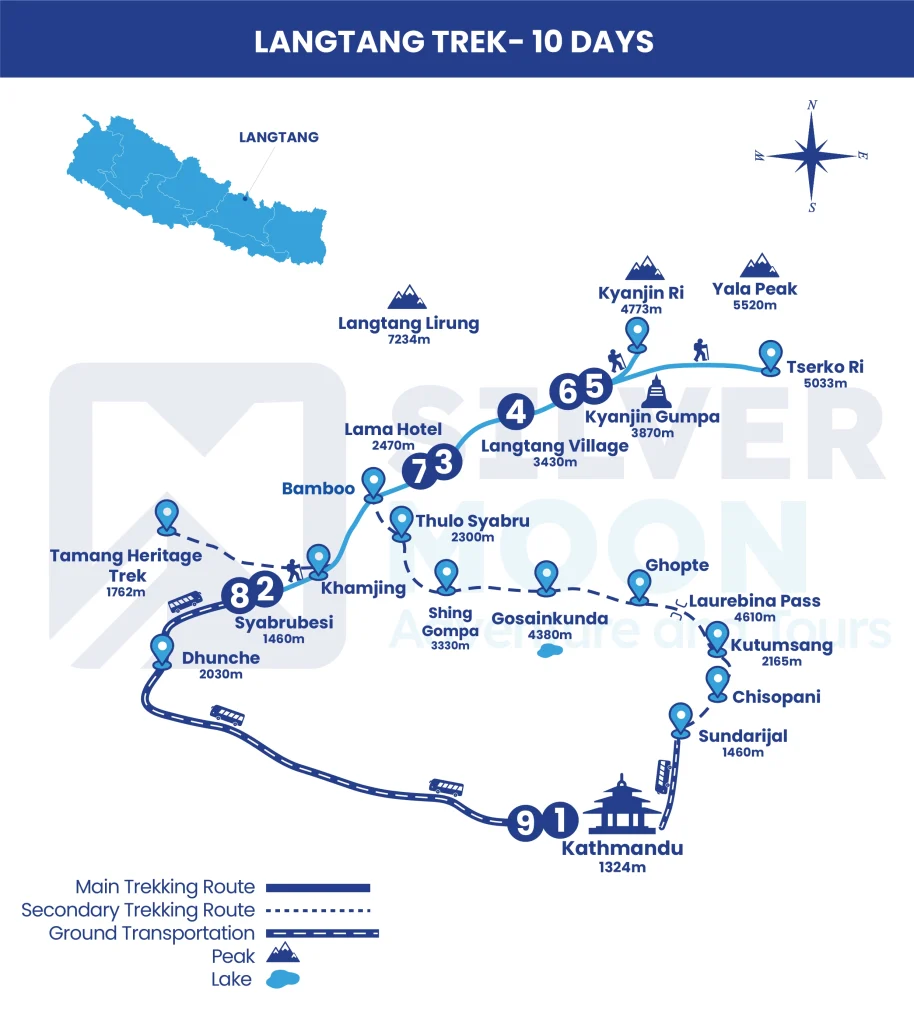
Trip Map
Additional information
Trekking Permits and Documentation
You need the necessary trekking permits to enter and trek through the Langtang region. The package includes the required entry permits, including the Langtang National Park permit.
Before starting your trek, make sure your passport is valid and that you have copies of important travel documents. It is also useful to keep digital copies of your passport, insurance details, and emergency contacts on your phone or in cloud storage.
Understanding the Trek Difficulty
The Langtang Trek is graded moderate. You do not need previous technical climbing experience, but you should be comfortable walking for several hours on uneven mountain trails.
Most trekking days involve around 5–7 hours of walking, with a mixture of gradual climbs, descents, stone paths, forest trails, and mountain terrain. The hike from Kyanjin Gompa toward Kyanjin Ri or Tserko Ri is considerably steeper and more demanding than the lower sections of the trek.
Preparing for the Trek
You do not need to be an experienced mountaineer for this journey, but some preparation will make the trek much more enjoyable.
In the weeks before your trip, try to include:
- Regular walking or hiking
- Stair climbing
- Jogging or cycling
- Leg and core exercises
- Longer weekend walks
- Practice with your trekking shoes and backpack
The goal is not to walk extremely fast. Building steady endurance is more useful because you will spend several consecutive days on the trail.
Altitude and Acclimatization
Altitude is an important part of the Langtang Trek. The itinerary takes you from Syabrubesi at around 1,550 meters to Kyanjin Gompa at approximately 3,870 meters, followed by a hike toward 4,800 meters or higher.
Your body needs time to adjust as you climb. Walk slowly, stay hydrated, eat properly, and avoid pushing yourself simply to keep up with others.
Pay attention to symptoms such as headache, dizziness, unusual tiredness, nausea, or difficulty sleeping. Tell your guide immediately if you feel unwell at altitude. The itinerary allows time around Kyanjin Gompa before the higher viewpoint hike, which helps provide an opportunity for acclimatization.
Accommodation Along the Trail
Accommodation during the trek is provided in local teahouses and lodges, while Kathmandu accommodation is in a 3-star hotel according to the current package.
Mountain teahouses are comfortable but basic compared with city hotels. Facilities can become simpler as you move higher into the valley.
Private rooms may be available in many villages, but availability can become limited during busy trekking periods. Hot showers and some other facilities may cost extra.
Food and Drinking Water
The package provides full-board meals during the trekking section. Common mountain meals include dal bhat, noodles, fried rice, pasta, soup, potatoes, eggs, pancakes, and other simple dishes.
Vegetarian food is generally available at teahouses along the route.
For drinking water, use treated, filtered, or properly purified water rather than drinking untreated water directly from streams or taps. The package provides water purification tablets, and carrying a reusable bottle is recommended.
Weather and Trail Conditions
Weather can change quickly in the Langtang mountains. Lower sections can feel relatively warm during the day, while temperatures drop significantly at higher elevations and after sunset.
Spring and autumn are the main trekking seasons listed for this itinerary. These periods generally offer favorable conditions for trekking and mountain views.
Winter is possible but brings colder temperatures and possible snowfall at higher elevations. During the monsoon, rain can make trails muddy or slippery and mountain visibility may be reduced.
Always carry a waterproof outer layer even when the morning begins with clear skies.
What to Pack
Pack according to the season, but keep your gear practical rather than unnecessarily heavy.
Important items include:
- Broken-in waterproof trekking boots
- Warm layers
- Waterproof and windproof jacket
- Trekking trousers
- Thermal layers
- Fleece or warm mid-layer
- Down or insulated jacket
- Warm hat and gloves
- Sunglasses
- Sunscreen and lip balm
- Headlamp
- Trekking poles
- Reusable water bottles
- Sleeping bag
- Personal medicines
- Basic first-aid supplies
- Power bank
- Backpack rain cover
- Quick-dry clothing
- Toiletries and personal hygiene items
The current equipment list also recommends a sleeping bag suitable for cold conditions and trekking poles for the mountain terrain.
Porter and Baggage
A porter can make the trek considerably more comfortable by carrying your main luggage while you walk with a lighter daypack.
If you use a porter, keep the items you need during the day in your own small backpack. Carry essentials such as water, snacks, sunscreen, a rain layer, camera, documents, and personal medication with you.
The current FAQ notes that a porter generally carries around 20–25 kg shared between two trekkers.
Electricity, Wi-Fi and Mobile Connectivity
Connectivity becomes less reliable as you move deeper into the mountains. Many teahouses offer Wi-Fi and charging facilities, but connections can be slow and charging may cost extra.
Nepal Telecom coverage is available in many parts of the route, although the signal can become weak at higher elevations.
A power bank is highly recommended. Keeping your phone in battery-saving mode can also help during longer trekking days.
Money and Personal Expenses
Carry enough Nepalese cash before heading into the trekking region. Although some teahouses may offer additional services, you should not depend on card payments or ATMs along the trail.
Keep some extra money for:
- Hot showers
- Additional drinks
- Snacks
- Wi-Fi or charging
- Personal purchases
- Tips
- Unexpected transportation or accommodation expenses
The package excludes personal expenses, hot showers, certain beverages, and tips.
Travel Insurance and Emergency Support
Travel insurance is strongly recommended for this trek. Because the route reaches high elevations, your policy should specifically cover high-altitude trekking and emergency medical evacuation.
The current package excludes trekking insurance and specifies coverage up to 5,500 meters with emergency helicopter evacuation.
Carry your insurance information and emergency contact details with you throughout the trek.
Photography in Langtang Valley
Langtang is an excellent destination for photography because the scenery changes dramatically throughout the trek.
You can capture:
- Forest trails
- Suspension bridges
- Waterfalls
- Tamang villages
- Prayer flags and mani walls
- Yak pastures
- Glaciers
- Kyanjin Gompa
- Snow-covered peaks
- Sunrise from Kyanjin Ri or Tserko Ri
At high elevations, batteries can drain faster in cold temperatures. Carry a power bank and keep spare batteries protected from extreme cold.
Always ask permission before photographing local people, especially monks, children, or people engaged in religious activities.
Respecting Tamang and Buddhist Culture
The Langtang region is home to communities with strong Tamang and Tibetan Buddhist cultural traditions.
When visiting monasteries or religious sites, dress respectfully and follow local customs. Walk around mani walls and religious objects in the appropriate direction rather than stepping over them.
Keep your voice low around monasteries and avoid touching religious objects unless invited to do so.
A respectful approach makes your cultural experience more meaningful and helps maintain good relationships between visitors and local communities.
Wildlife and the Natural Environment
Langtang National Park contains diverse Himalayan ecosystems, from lower forests to alpine landscapes. Wildlife in the region includes birds, langurs, musk deer, and other Himalayan species. The area is also known for the possibility of encountering the elusive red panda.
Wildlife sightings are never guaranteed, so enjoy the natural environment without disturbing animals.
Do not feed wildlife, leave food waste on the trail, or make unnecessary noise when moving through forest areas.
Responsible Trekking
Langtang is a beautiful but sensitive mountain environment. Small actions from trekkers can make a meaningful difference.
Carry your waste until you reach an appropriate disposal point, avoid unnecessary single-use plastics, use refillable water bottles, and respect local water sources.
Supporting local teahouses, guides, porters, shops, and community services also helps keep tourism benefits within the region.
Tipping Guides and Porters
Tipping is not a strict fee, but it is a common way for trekkers to show appreciation to guides and porters for their work.
If you are happy with the service, you can provide a tip at the end of the trek. The amount can depend on the quality and length of service, group size, and your personal budget.
It is usually best to give tips directly and thank the team personally.
Road Travel and Itinerary Flexibility
Unlike many popular Himalayan treks, the Langtang Trek does not require a domestic mountain flight. The itinerary uses road transportation between Kathmandu and Syabrubesi.
This makes the trek relatively straightforward from a transportation perspective, but road conditions can still affect travel times.
Weather, road conditions, local circumstances, or trail conditions may occasionally require changes to the planned schedule. Keeping some flexibility in your travel plans is especially useful if you have an international flight immediately after the trek.
Best Time for the Langtang Trek
The current itinerary recommends spring from March to May and autumn from late September to November. These seasons are generally popular for Himalayan trekking because of favorable walking conditions and better opportunities for mountain views.
Spring brings blooming rhododendrons and fresh mountain landscapes, while autumn is known for clearer mountain scenery after the monsoon.
Winter offers a quieter experience but can be significantly colder, while monsoon brings more rain and potentially slippery trails.
Who Is This Trek Suitable For?
The Langtang Trek can suit both first-time trekkers and experienced hikers who want a shorter Himalayan adventure. Previous trekking experience is not essential, but good physical fitness and preparation are important.
It is particularly suitable if you want to experience:
- Himalayan mountain scenery
- Traditional Tamang villages
- Buddhist culture
- Forest and alpine landscapes
- Kyanjin Gompa
- A high-altitude viewpoint hike
- A trek accessible by road from Kathmandu
- A shorter alternative to longer Himalayan routes
A Few Things to Keep in Mind
The Langtang Trek may be shorter than some major Himalayan expeditions, but the higher sections should still be taken seriously. The combination of long walking days, changing weather, uneven trails, and altitude requires proper preparation.
Start your walking days at a comfortable pace, stay hydrated, listen to your guide, and give your body time to adjust. Most importantly, enjoy the journey rather than treating the trek as a race to reach Kyanjin Ri.
The forests, villages, mountain trails, Buddhist culture, glaciers, and views around Kyanjin Gompa are all part of the experience. Taking time to appreciate these details is what makes the Langtang Valley Trek more than simply a walk to a high viewpoint.
FAQs for this trip
General
-
How long is the Langtang Trek?
The trek takes 10 days, including your arrival, departure, and travel between Kathmandu and Syabrubesi.
-
What is the highest point of the trek?
The highest point is Kyanjin Ri (4,800 m). Trekkers can also choose to hike to Tserko Ri (5,033 m) for even wider mountain views.
-
Is the Langtang Trek suitable for beginners?
Yes. The trek is suitable for beginners who are in good physical condition. No technical climbing experience is needed.
-
Why choose the Langtang Trek?
The Langtang Trek is perfect if you want a shorter Himalayan adventure with fewer crowds. It offers beautiful landscapes, traditional villages, glaciers, forests, and spectacular mountain scenery.
Difficulty and Physical Fitness
-
How difficult is the Langtang Trek?
The Langtang Trek is moderately difficult. It includes gradual climbs, mountain trails, and daily walks through forests and valleys.
-
How many hours do we walk each day?
You will usually walk 5 to 7 hours each day.
-
Do I need previous trekking experience?
No. Previous trekking experience is helpful but not necessary. Good fitness and preparation are enough for most trekkers.
-
How should I prepare for the trek?
Walking, hiking, jogging, cycling, or climbing stairs for a few weeks before your trip will improve your stamina.
Altitude and Health
-
Can I get altitude sickness?
Yes. Since the trek reaches 4,800 meters, there is a chance of mild altitude sickness.
-
How can I prevent altitude sickness?
Walk at a steady pace, drink plenty of water, eat well, and listen to your guide’s advice.
-
Is there an acclimatization day?
Yes. The itinerary includes time at Kyanjin Gompa, allowing your body to adjust before hiking to Kyanjin Ri or Tserko Ri.
Route and Itinerary
-
Where does the trek start?
The journey begins with a scenic drive from Kathmandu to Syabrubesi, the gateway to the Langtang region.
-
Which places do we visit?
The trek passes through Syabrubesi, Lama Hotel, Langtang Village, Kyanjin Gompa, and Kyanjin Ri before returning to Syabrubesi.
-
Do we visit Kyanjin Gompa?
Yes. You’ll visit the famous Kyanjin Gompa, explore the monastery, and even visit the local yak cheese factory.
-
Can the itinerary be customized?
Yes. The itinerary can be adjusted to match your schedule and fitness level.
Accommodation
-
Where will I stay during the trek?
You will stay in comfortable hotels in Kathmandu and local teahouses during the trek.
-
Are private rooms available?
Private rooms are available in many villages but may be limited during busy trekking seasons.
-
Are hot showers available?
Yes. Most teahouses provide hot showers for an additional charge.
-
Do I need a sleeping bag?
Yes. A warm sleeping bag is recommended, especially during colder months.
Food and Drinks
-
What meals are available?
You can enjoy Dal Bhat, noodles, fried rice, pasta, soup, potatoes, eggs, pancakes, tea, and coffee.
-
Is vegetarian food available?
Yes. Vegetarian meals are available at almost every teahouse.
-
Is drinking water safe?
Drink boiled or purified water instead of untreated tap water.
Weather and Best Time
-
When is the best time for the Langtang Trek?
The best seasons are spring (March to May) and autumn (September to November), when the weather is clear and mountain views are excellent.
-
Can I trek during winter?
Yes. Winter trekking is possible, but temperatures are much colder and snowfall is common at higher elevations.
-
Is the trek possible during the monsoon?
Yes, but rain can make the trails muddy and slippery, and mountain views may be limited.
Permits and Regulations
-
What permits are required?
You need a Langtang National Park Entry Permit to complete the trek.
-
Are permits included in the package?
Yes. All required trekking permits are included in the package.
-
Do I need a guide?
A licensed guide is highly recommended for safety, navigation, and learning about the local culture.
Flights and Transportation
-
How do I reach the trekking starting point?
You will travel by tourist bus or shared jeep from Kathmandu to Syabrubesi.
-
How do I return after the trek?
After completing the trek, you will drive back from Syabrubesi to Kathmandu.
-
Are domestic flights required?
No. The Langtang Trek uses road transportation only.
Equipment and Packing
-
What should I pack?
Bring warm clothing, trekking boots, a waterproof jacket, gloves, a warm hat, sunglasses, sunscreen, trekking poles, and a reusable water bottle.
-
Can I rent trekking gear?
Yes. Trekking gear such as sleeping bags, down jackets, and trekking poles can be rented in Kathmandu.
-
Do I need trekking poles?
Yes. Trekking poles are useful for steep climbs and descents.
-
Should I bring a first-aid kit?
Yes. Carry your personal medications and a basic first-aid kit.
Connectivity and Electricity
-
Is Wi-Fi available?
Yes. Many teahouses offer Wi-Fi, but the connection may be slow in remote areas.
-
Can I charge my phone or camera?
Yes. Charging facilities are available in most villages, sometimes for an additional fee.
-
Is there mobile network coverage?
Yes. Nepal Telecom has coverage in many parts of the trek, but the signal may be weak at higher elevations.
Guides and Porters
-
Is a guide included?
Yes. A professional English-speaking trekking guide is included in the package.
-
Can I hire a porter?
Yes. Porters are available to carry your luggage and make your trek more comfortable.
-
How much weight can a porter carry?
A porter usually carries 20–25 kg, shared between two trekkers.
-
Why should I hire a porter?
A porter helps reduce your physical effort, allowing you to enjoy the trek while supporting local communities.
Cost and Booking
-
What is included in the package?
The package includes airport transfers, hotel accommodation in Kathmandu, teahouse accommodation, meals during the trek, permits, a professional guide, government taxes, and other listed services.
-
What is not included?
International flights, Nepal visa fees, travel insurance, personal expenses, alcoholic drinks, hot showers, Wi-Fi charges, and tips are not included.
-
When should I book this trek?
Booking at least one month in advance is recommended, especially during spring and autumn.
-
Is a deposit required?
Yes. A deposit is required to confirm your booking and arrange trekking permits and other services.
Photography and Experience
-
Is the Langtang Trek good for photography?
Yes. The trek offers beautiful forests, waterfalls, glaciers, traditional villages, suspension bridges, and panoramic mountain views.
-
Which mountains can I see?
You can enjoy spectacular views of Langtang Lirung, Dorje Lakpa, Gangchempo, Yala Peak, and Naya Kanga.
-
What makes the Langtang Trek special?
The Langtang Trek is less crowded than Everest and Annapurna, making it perfect for trekkers who want a peaceful Himalayan experience while enjoying rich Tamang culture and stunning natural beauty.
-
What are the highlights of the trek?
The main highlights include Langtang National Park, Kyanjin Gompa, Kyanjin Ri, traditional Tamang villages, yak pastures, glaciers, and incredible Himalayan landscapes.


USD 540PP
Why book with us?
- Local Guides & Porters
- 98% Success Trip Rate
- Comfort Priority and Saftey Trip
- Satisfied Client
-
Group Size Discounts
Discounts are solely based on your group size. We don’t add anyone to the group.
No. of people Price per person 1 pax USD 680 2-6 pax USD 540 7+ pax USD 495
Send Quick Email
Similar trips
View all trips
Makalu Base Camp Trek – 20 Days
Explore the Makalu Base Camp Trek in Nepal with our 20-day Himalayan adventure package.
Royal Trek Nepal – 10 Day Trekking Package
Explore Royal Trek Nepal with Himalayan scenery, cultural sightseeing, and authentic village experiences.
Nar Phu Valley Trek
Experience remote Nar Phu Valley with Kang La Pass, culture, and Himalayan adventure.