The Manaslu Circuit and Tsum Valley Trek is one of the best treks in Nepal for those seeking a peaceful, remote mountain adventure combining the beautiful scenery of the Manaslu region and Tsum Valley.
OverviewManaslu Circuit and Tsum Valley Trek – 20 days


USD 1,190PP
Why book with us?
- Local Guides & Porters
- 98% Success Trip Rate
- Comfort Priority and Saftey Trip
- Satisfied Client
-
Group Size Discounts
Discounts are solely based on your group size. We don’t add anyone to the group.
No. of people Price per person 1 pax USD 1580 2-4 pax USD 1280 5-10 pax USD 1160 11+ pax USD 1150
Send Quick Email

Duration
20 Days

Max Alitiude
5,160m at Larkya La Pass

Transportation
Tourist Bus / Shared Jeep

Trip Grade
Moderate to Challenging

Activity
Trekking

Start/End Point
Machha Khola / Dharapani

Best Season
Spring (March - May) & Autumn (late September - November)

Meals
Full board during trek (Breakfast, Lunch, Dinner)

Accommodation
Hotels (Kathmandu), Teahouses during trek
Trip Overview
The Manaslu Circuit and Tsum Valley Trek is one of the best treks in Nepal for those seeking a peaceful, remote mountain adventure. This trek combines the beautiful scenery of the Manaslu region with the rich Tibetan Buddhist culture of the hidden Tsum Valley. The trail passes through traditional villages, forests, rivers, and high mountain landscapes with amazing Himalayan views. This trek is perfect for travelers who want beautiful mountain scenery, local culture, and an authentic trekking experience in Nepal.
If you have ever compared the busy Everest and Annapurna regions, the Manaslu and Tsum Valley area remains quiet, less commercialized, and culturally preserved. The trail goes through deep river valleys, suspension bridges, waterfalls, pine and rhododendron forests, alpine meadows, and beautiful mountain landscapes. Along the journey, you will pass through small Himalayan villages and experience the warm hospitality of local people.
The journey starts with a drive from Kathmandu to Machha Khola. Along the way, you will see green hills, terraced fields, and small riverside villages. From Machha Khola, the trek follows the Budhi Gandaki River into the remote Manaslu region.
One of the best parts of the trek is visiting Tsum Valley. Known as the “Hidden Valley of Happiness,” Tsum Valley is famous for its preserved Tibetan Buddhist culture and traditional mountain villages. Places like Chumling, Chekampar, and Nile give trekkers a chance to experience local Himalayan life and culture.
A special side trip leads to Mu Gompa, one of the highest monasteries in the region. Surrounded by barren hills and snow-covered mountains, Mu Gompa offers peaceful surroundings, a spiritual atmosphere, and incredible Himalayan scenery.
After exploring Tsum Valley, you will now reconnect with the classic Manaslu Circuit route and continue through Namrung, Shyala, Samagaon, and Samdo. During this section, you will enjoy breathtaking views of Mount Manaslu (8,163 meters), the eighth-highest mountain in the world, as well as Himalchuli, Ganesh Himal, and other snow-capped Himalayan peaks.
Samagaon is one of the most beautiful villages on the trek. An acclimatization day here allows trekkers to explore nearby attractions, including Manaslu Base Camp and Birendra Lake. Birendra Lake is a stunning turquoise glacial lake located below massive icefalls and surrounded by alpine landscapes. The peaceful environment and mountain backdrop make it one of the most memorable places in the Manaslu region.
The trek slowly reaches higher areas where the scenery becomes more open and rugged. Along the way, you will pass through Samdo, a small village close to the Tibetan border. Snowy mountains surround the village and offer a chance to see the simple lifestyle of local Himalayan people.
Manaslu Circuit and Tsum Valley Trek Highlights
The biggest challenge and highlight of the trek is crossing the Larke Pass (5,160 meters), one of Nepal’s most scenic high-altitude passes. From the top of the pass, trekkers are rewarded with panoramic views of Himlung Himal, Cheo Himal, Kang Guru, Annapurna II, and many other Himalayan peaks.
After crossing the pass, the trail goes downhill into the greener Annapurna region. The route passes through the beautiful Bimthang before reaching Dharapani, where the trek ends. From there, you will drive back to Kathmandu.
The 20-day Manaslu Circuit and Tsum Valley Trek is a perfect adventure for trekkers who love remote mountain trails and natural beauty. The journey includes long walking days and high-altitude paths, but the stunning mountain views, rich local culture, and quiet landscapes make it a memorable experience.
This trek offers a complete Himalayan experience with remote villages, sacred monasteries, glacier landscapes, hidden valleys, rich Buddhist culture, and world-class mountain views. For travelers seeking an off-the-beaten-path trekking experience in Nepal, the Manaslu Circuit and Tsum Valley Trek is one of the finest adventures in the Himalayas.
Trip Highlights
- Explore the remote and culturally rich Tsum Valley, one of Nepal’s hidden Himalayan valleys.
- Trek around the spectacular Manaslu region, home to the world’s eighth-highest mountain, Mount Manaslu (8,163m).
- Cross the breathtaking Larkya La Pass (5,160m), one of the most scenic high mountain passes in Nepal.
- Visit ancient Buddhist monasteries, including the famous Mu Gompa near the Tibetan border.
- Enjoy incredible mountain views of Manaslu, Ganesh Himal, Himalchuli, Ngadi Chuli, Annapurna II, and Himlung Himal.
- Visit the beautiful Manaslu Base Camp or glacial Birendra Lake during acclimatization in Samagaon.
When to visit
J
F
M
A
M
J
J
A
S
O
N
D
- Average time to visit
- Best time to visit
- Good time to visit
Outline Itinerary
- Day 01: Arrive at Tribhuwan International Airport and transfer to the hotel.
- Day 02: Drive from Kathmandu to Machha Khola by public bus.
- Day 03: Trek to Jagat.
- Day 04: Trek to Lokpa.
- Day 05: Trek to Chumling.
- Day 06: Trek to Chekampar (also called Chokhangparo).
- Day 07: Trek to the Nile.
- Day 08: Day Trip to Mu Gompa. Overnight, if possible, or return to the Nile.
- Day 09: Trek to Chumling from Nile or Mu Gompa.
- Day 10: Trek to Deng.
- Day 11: Trek to Namrung.
- Day 12: Trek to Shyala.
- Day 13: Trek to Samagaon.
- Day 14: Acclimatization Day (Day Trip to Manaslu Base Camp).
- Day 15: Trek to Samdo.
- Day 16: Trek to Dharamsala/Larkya Phedi.
- Day 17: Cross Larkya La Pass (5,160m) and trek to Bimthang (2,300m).
- Day 18: Trek to Dharapani.
- Day 19: Drive to Kathmandu.
- Day 20: Departure
Trip Itinerary
-
Day 01
Arrive at Tribhuwan International Airport and transfer to the hotel.
Upon arrival at Tribhuvan International Airport in Kathmandu, our representative will welcome you and transfer you to your hotel.
After check-in, you can relax at the hotel or explore nearby areas such as Thamel.
Overnight in Kathmandu.
-

Max. Altitude: 1,400m (4,600 feet)
-

Accommodation: 3-star Hotel
-
Meals: Dinner
-
-
Day 02
Drive from Kathmandu to Machha Khola by public bus.
Today, you will take a scenic drive to Machha Khola, the start point of the trek. The drive will be alongside the Trishuli River before entering the hilly roads of the Budhi Gandaki region.
Along the way, you pass through towns like Dhading Besi, Arughat, and Soti Khola, enjoying beautiful views of terraced fields, waterfalls, and traditional hillside villages.
After several hours of driving through rugged mountain roads, you arrive at the small riverside settlement of Machha Khola.
Overnight in Machha Khola.
-
Max. Altitude: 869m (2,851 feet)
-
Accommodation: Teahouse / Lodge
-
Meals: Breakfast, Lunch, Dinner
-
Drive duration: 6-7 hours’ drive
-
-
Day 03
Trek to Jagat.
Today, the trek officially begins, and you will start by following the Budhi Gandaki River through narrow valleys and forested trails. This trail to Jagat includes several suspension bridges, stone staircases, and small traditional settlements.
You will first pass through the village of Khorlabesi before reaching Tatopani, a place once famous for its natural hot springs. Continuing onward, you will cross rocky sections, waterfalls, and riverside paths. The impressive views of steep hillsides and deep river gorges are what make this trail easier.
By afternoon, you will arrive at Jagat. Jagat is a charming stone-paved village that is the official entry checkpoint for the Manaslu Conservation Area.
Overnight in Jagat.
-
Max. Altitude: 1,340m (4,396 feet)
-
Accommodation: Teahouse or Lodge
-
Meals: Breakfast, Lunch, Dinner
-

Trek Duration: 7-8 hours trek
-
-
Day 04
Trek to Lokpa.
After breakfast, you will continue trekking through beautiful terraced hillsides and traditional Gurung villages. The trail gradually climbs toward Salleri and then descends toward Sirdibas.
You will continue walking to Philim, one of the largest villages in the lower Manaslu region. Philim is known for its Buddhist culture, stone houses, and scenic mountain surroundings.
Later, you will leave the main Manaslu Circuit route and enter the remote Tsum Valley region. As you move deeper into the valley, the trail becomes quieter and less crowded. You will walk through dense pine and rhododendron forests while crossing narrow ridges and suspension bridges.
By late afternoon, you will reach Lokpa, the first village inside the hidden Tsum Valley. The village offers peaceful surroundings and beautiful views of Ganesh Himal.
Overnight in Lokpa.
-
Max. Altitude: 2,240m (7,349 feet)
-
Accommodation: Teahouse or Lodge
-
Meals: Breakfast, Lunch, Dinner
-
Trek Duration: 7-8 hours trek
-
-
Day 05
Trek to Chumling.
Today’s trail starts with a walk through dense forest before crossing the Budhi Gandaki River on a suspension bridge. The trail then climbs slowly through peaceful forest paths and small villages.
As you enter lower Tsum Valley, you will begin noticing strong Tibetan Buddhist influences in the architecture, prayer flags, mani walls, and monasteries.
You will eventually arrive at Chumling, a beautiful traditional village surrounded by terraced fields and mountain scenery. The village offers stunning views of Ganesh Himal and nearby peaks.
After reaching Chumling, you can explore the local monastery and observe the peaceful lifestyle of the local people.
Overnight in Chumling.
-
Max. Altitude: 2,386m (7,828 feet)
-
Accommodation: Teahouse or Lodge
-
Meals: Breakfast, Lunch, Dinner
-
Trek Duration: 5-6 hours trek
-
-
Day 06
Trek to Chekampar (also called Chokhangparo).
After breakfast, you will cross a suspension bridge and continue trekking through fertile valleys and small Tibetan-influenced villages. The trail climbs gradually, and as you move forward, you will witness the excellent views of Ganesh Himal.
You will pass through villages such as Rainjam and Gho as you walk alongside prayer walls, chortens, and Buddhist landmarks. The landscape becomes more open as the valley widens and the mountain scenery grows more dramatic.
By afternoon, you will arrive at Chekampar, also known as Chokhangparo, one of the most culturally important villages in Tsum Valley. This beautiful village is home to traditional Tibetan communities who still follow ancient Buddhist customs and lifestyles. The surrounding mountain views from Chekampar are spectacular, especially during sunset.
Overnight in Chekampar.
-
Max. Altitude: 3,031m (9,944 feet)
-
Accommodation: Teahouse or Lodge
-
Meals: Breakfast, Lunch, Dinner
-
Trek Duration: 6-7 hours trek
-
-
Day 07
Trek to the Nile.
Today, you will continue deeper into the upper Tsum Valley. The trail passes through Lamagaon and Chhule, two traditional Himalayan villages rich in Buddhist culture and Tibetan heritage.
Along the route, you will see colorful prayer flags, ancient mani walls, and yak grazing fields surrounded by barren mountain landscapes.
As you gain altitude, the scenery becomes more rugged and alpine. The peaceful environment and quiet trails make this one of the most rewarding sections of the trek.
After several hours of trekking, you will arrive at Nile, the last village before the Tibetan border. Nile is a small and peaceful settlement surrounded by dramatic Himalayan landscapes.
Overnight in Jagat.
-
Max. Altitude: 3,361m (11,026 feet)
-
Accommodation: Teahouse or Lodge
-
Meals: Breakfast, Lunch, Dinner
-
Trek Duration: 6-7 hours trek
-
-
Day 08
Day Trip to Mu Gompa. Overnight, if possible, or return to the Nile.
Today, you will hike to the famous Mu Gompa, the largest and oldest monastery in the Tsum Valley region. The trail climbs gradually through dry alpine terrain with incredible mountain views along the way.
As you approach Mu Gompa, you will notice the isolated beauty and spiritual atmosphere of this remote Himalayan monastery.
You will have time to explore the monastery, interact with local monks, and enjoy panoramic views of the surrounding mountains and Tibetan landscapes.
Depending on the weather and accommodation availability, you may stay overnight at Mu Gompa or return to the Nile after the visit.
This day offers one of the most unique cultural experiences of the entire trek.
Overnight in Mu Gompa.
-
Max. Altitude: 3,700m (12,139 feet)
-
Accommodation: Teahouse or Lodge
-
Meals: Breakfast, Lunch, Dinner
-
Trek Duration: 7-8 hours trek
-
-
Day 09
Trek to Chumling from Nile or Mu Gompa.
After breakfast, you will begin descending back through the beautiful Tsum Valley. Walking downhill allows you to enjoy different perspectives of the mountains, monasteries, and traditional villages you passed earlier.
You will retrace the trail through Chhule and Chekampar while enjoying peaceful Himalayan scenery and local village life.
After several hours of trekking, you will reach Chumling for an overnight stay.
The lower altitude and warmer weather will feel more comfortable after spending time in the upper valley.
Overnight in Chumling.
-
Max. Altitude: 2,386m (7,828 feet)
-
Accommodation: Teahouse or Lodge
-
Meals: Breakfast, Lunch, Dinner
-
Trek Duration: 5-6 hours trek
-
-
Day 10
Trek to Deng.
Today, you will leave Tsum Valley and rejoin the main Manaslu Circuit route. The trail goes downhill through forests and river valleys before crossing several suspension bridges.
You will pass through small villages and enjoy views of waterfalls, cliffs, and deep river gorges.
As you continue trekking, you will notice a gradual change in landscape and culture as the trail reconnects with the Manaslu region.
By afternoon, you will arrive at Deng, a small village with Tibetan-influenced culture and traditional stone houses.
Overnight in Deng.
-
Max. Altitude: 1,860m (6,102 feet)
-
Accommodation: Teahouse or Lodge
-
Meals: Breakfast, Lunch, Dinner
-
Trek Duration: 5-6 hours trek
-
-
Day 11
Trek to Namrung.
After breakfast, you will continue trekking through beautiful pine forests and narrow valleys. The trail frequently crosses the Budhi Gandaki River on suspension bridges as it gradually climbs higher into the mountains.
You will pass through villages such as Bihi Phedi and Ghap, where you can see prayer stones carved with Buddhist mantras.
The route offers increasingly impressive views of the surrounding peaks as you gain altitude.
By late afternoon, you will arrive at Namrung. Namrung is a traditional mountain village where you can see the stone houses, monasteries, and stunning Himalayan scenery.
Overnight in Namrung.
-
Max. Altitude: 2,630m (8,629 feet)
-
Accommodation: Teahouse or Lodge
-
Meals: Breakfast, Lunch, Dinner
-
Trek Duration: 7-8 hours trek
-
-
Day 12
Trek to Shyala.
Today is one of the most scenic trekking days of the entire journey. You will trek through alpine forests and traditional villages while enjoying close-up views of Mount Manaslu and nearby Himalayan peaks.
The trail passes through Lho, a beautiful village known for its monastery and panoramic mountain scenery. You will continue through open valleys surrounded by snow-covered mountains before reaching Shyala.
Shyala is a peaceful village located in a wide valley with breathtaking views in every direction. Peaks such as Manaslu, Himalchuli, and Ngadi Chuli dominate the skyline.
Overnight in Shyala.
-
Max. Altitude: 3,500m (11,482 feet)
-
Accommodation: Teahouse or Lodge
-
Meals: Breakfast, Lunch, Dinner
-
Trek Duration: 7-8 hours trek
-
-
Day 13
Trek to Samagaon.
After enjoying the incredible mountain sunrise in Shyala, you will continue trekking toward Samagaon. Although today is a shorter trekking day, the scenery remains spectacular throughout the route.
The trail passes through wide alpine valleys, yak grazing fields, and traditional stone houses. Along the way, you will have uninterrupted views of Mount Manaslu, glaciers, and surrounding snow-covered peaks.
As you get closer to Samagaon, you will notice the strong Tibetan Buddhist culture reflected in the local architecture, prayer wheels, mani walls, and monasteries.
Samagaon is one of the largest and most important villages in the Manaslu region. The village sits beneath the massive north face of Mount Manaslu and offers a peaceful atmosphere surrounded by dramatic Himalayan scenery.
After arriving, you can spend the afternoon resting, exploring the village, or visiting the nearby monastery.
Overnight in Samagaon.
-
Max. Altitude: 3,530m (11,581 feet)
-
Accommodation: Teahouse or Lodge
-
Meals: Breakfast, Lunch, Dinner
-
Trek Duration: 4-5 hours trek
-
-
Day 14
Acclimatization Day (Day Trip to Manaslu Base Camp).
Today is an important acclimatization day to help your body adjust to the higher altitude before crossing Larkya La Pass.
After breakfast, you will take a side trip toward Manaslu Base Camp or Birendra Lake, depending on your fitness level and weather conditions.
The trail to Manaslu Base Camp climbs gradually through rocky glacial terrain and offers breathtaking views of Mount Manaslu, surrounding glaciers, and Himalayan peaks. The landscape becomes more rugged and dramatic as you gain elevation.
If you choose the shorter hike to Birendra Lake, you will see a beautiful glacial lake below the Manaslu Glacier. The clear blue water and mountain views make the place very special.
After spending time enjoying the scenery and taking photographs, you will return to Samagaon for rest and an overnight stay.
This acclimatization day greatly improves your chances of safely crossing the high mountain pass later in the trek.
Overnight at Samagaon.
-
Max. Altitude: 3,530m (11,581 feet)
-
Accommodation: Teahouse or Lodge
-
Meals: Breakfast, Lunch, Dinner
-
Trek Duration: 4 hours
-
-
Day 15
Trek to Samdo.
Today, you will continue trekking higher into the remote Himalayan landscape. The trail gradually ascends through open valleys with fewer trees and more barren mountain terrain.
You will pass yak pastures, ancient trade routes, and stone shelters used by local herders. Throughout the day, you can enjoy incredible views of glaciers, snow-covered mountains, and dramatic rocky hillsides.
The route follows an old trading route once used between Nepal and Tibet.
After several hours of gradual climbing, you will arrive at Samdo, a remote Tibetan refugee village located close to the Nepal-Tibet border.
Samdo offers stunning views of the surrounding mountains and a unique opportunity to experience traditional Himalayan life in one of Nepal’s most isolated settlements.
You can spend the afternoon resting or taking a short acclimatization walk above the village for even better views of the mountains.
Overnight in Samdo.
-
Max. Altitude: 3,860m (12,664 feet)
-
Accommodation: Teahouse / Lodge
-
Meals: Breakfast, Lunch, Dinner
-
Trek Duration: 3-4 hours trek
-
-
Day 16
Trek to Dharamsala/Larkya Phedi.
After breakfast, you will begin trekking toward Dharamsala, also known as Larkya Phedi, the final stop before crossing Larkya La Pass.
You will climb across rocky terrain and glacial moraines. Since the altitude increases significantly today, the pace will remain slow and steady.
Along the way, you will pass seasonal grazing areas and enjoy panoramic views of the surrounding Himalayan peaks.
As you continue higher, the landscape becomes more rugged, cold, and alpine. Eventually, you will reach Dharamsala, a small settlement used mainly by trekkers preparing for the pass crossing.
After arriving, you will rest early and prepare for one of the most challenging and rewarding days of the trek.
Your guide will brief you on the early start the next morning and the conditions at Larkya La Pass.
Overnight in Dharamsala.
-
Max. Altitude: 4,460m (14,633 feet)
-
Accommodation: Teahouse / Lodge
-
Meals: Breakfast, Lunch, Dinner
-
Trek Duration: 3-4 hours trek
-
-
Day 17
Cross Larkya La Pass (5,160m) and trek to Bimthang (2,300m).
Today is the longest, most challenging, and most rewarding day of the entire trek.
You will wake up very early in the morning and begin the ascent toward Larkya La Pass before sunrise. The trail gradually climbs through rocky, snowy terrain, offering incredible mountain views in every direction.
From the top of the Larkya La Pass, you will witness panoramic views of Mount Manaslu, Himlung Himal, Cheo Himal, Kang Guru, and Annapurna II.
Colorful prayer flags mark the summit of the pass, creating an unforgettable Himalayan atmosphere.
After spending time at the pass for photographs and rest, you will begin the long descent toward Bimthang. The downhill section can be steep and tiring, but the changing scenery is spectacular.
As you descend, the dry alpine landscape slowly transforms into greener valleys, forests, and glacial streams.
By late afternoon, you will arrive at Bimthang, a beautiful alpine settlement surrounded by mountains and open valleys.
This is one of the most memorable days of the entire Manaslu Circuit and Tsum Valley Trek.
Overnight in Bimthang.
-
Max. Altitude: 5,160m (12,664 feet)
-
Accommodation: Teahouse / Lodge
-
Meals: Breakfast, Lunch, Dinner
-
Trek Duration: 10-11 hours trek
-
-
Day 18
Trek to Dharapani.
After breakfast, you will begin descending through beautiful rhododendron forests, pine trees, and peaceful alpine meadows.
The trail follows glacial rivers and crosses several wooden bridges while offering final views of the snow-covered peaks behind you.
You will pass through villages such as Gho and Tilije, where you can observe traditional mountain lifestyles and local farming communities.
As the altitude decreases, the weather becomes warmer, and the vegetation becomes greener.
Eventually, you will arrive at Dharapani, a busy village that connects the Manaslu Circuit with the Annapurna Circuit trekking route.
After several days in remote mountain landscapes, Dharapani feels livelier and more developed.
You can relax and celebrate the successful completion of the trekking portion of your journey.
Overnight in Dharapani.
-
Max. Altitude: 3,860m (12,664 feet)
-
Accommodation: Teahouse / Lodge
-
Meals: Breakfast, Lunch, Dinner
-
Trek Duration: 7-8 hours trek
-
-
Day 19
Drive to Kathmandu.
Today, you will leave the mountains behind and begin the long scenic drive back to Kathmandu.
The journey follows mountain roads through villages, rivers, waterfalls, terraced fields, and green hills. Along the way, you will pass through Besisahar before returning to Kathmandu.
After days spent in remote Himalayan regions, returning to the busy capital city feels like a completely different experience.
Upon arrival in Kathmandu, you will transfer to your hotel and have free time to relax, shop for souvenirs, or enjoy a final evening in Nepal.
In the evening, you may choose to celebrate the completion of your Manaslu Circuit and Tsum Valley adventure with your trekking crew and fellow travelers.
Overnight in Kathmandu.
-
Accommodation: 3-star Hotel
-
Meals: Breakfast, Lunch, Dinner
-
Drive duration: 7-8 hours’ drive
-
-
Day 20
Departure
Today marks the end of your Manaslu Circuit and Tsum Valley Trek.
Depending on your flight schedule, you will be transferred to Tribhuvan International Airport for your international departure.
You will take home unforgettable memories of remote villages, monasteries, mountain views, and the experience of crossing Larkya La Pass.
-
Meals: Breakfast
-


Trip notes
You should be prepared for basic teahouse facilities and limited internet or charging availability at higher elevations. Proper acclimatization, warm clothing, and travel insurance covering high-altitude trekking are strongly recommended.
Since weather and mountain conditions can change quickly, carrying essential personal medications and a reusable water bottle with purification tablets is advisable.
Cost Includes
- Airport picks up and drops off.
- All necessary trekking permits (Manaslu Restricted Area Permit, Manaslu Conservation Area Permit, Annapurna Conservation Area Permit, Tsum Valley Restricted Area Permit, TIMS, or equivalent).
- Hotel accommodation in Kathmandu (twin sharing)
- Teahouse/Lodge accommodation during the trek.
- Three meals a day (breakfast, lunch, dinner) during the trek.
- Professional English Speaking trekking guide.
- Guide insurance, salary, food, and lodging.
- All government and local taxes.
Cost Excludes
- International airfares.
- Nepal entry visa fees.
- Porter (1 porter for two trekkers) (+USD 360)
- All personal expenses, including alcohol & other beverages, trekking equipment, travel insurance, and more.
- Extra expenses during the trek, like hot shower charge, battery charging, Wi-Fi, and any others.
- Tips for the trekking guides and porters.
- Additional hotel stays in Kathmandu, or anywhere, if not on the planned itinerary.
- Any expenses not mentioned in the “Includes” section.
Gears and Equipment
You are seeing the list of gears and equipment needed for this trip. Please check the items carefully and make sure you pack everything required for the journey.
The equipment may vary depending on the weather, location, altitude, and activities included in the itinerary. Some special gear may be provided or available for rent if needed.

Head & Face Protection
- Sun cap or hat
- Warm beanie (wool/fleece)
- Neck gaiter/buff
- UV-protection sunglasses (Category 3 or 4)
- Headlamp with spare batteries

Upper Body Clothing (Layer System)
- Moisture-wicking base layer (2–3 sets)
- Fleece or light warm mid-layer
- Insulated down jacket (cold-weather essential)
- Waterproof + windproof outer shell jacket
- Quick-dry trekking t-shirts

Lower Body Clothing
- Trekking pants (lightweight, stretchable)
- Thermal base layer leggings
- Waterproof rain pants

Backpack & Carrying Gear
- Main backpack (40–50L) with rain cover
- Daypack (optional if using porter)
- Dry bags / plastic bags for organization

Footwear & Socks
- Waterproof trekking boots (ankle support, broken-in)
- Camp shoes/sandals
- Warm trekking socks (2–4 pairs)
- Liner socks (blister prevention)

Hand Protection
- Lightweight inner gloves
- Warm insulated gloves (preferably waterproof)

Hygiene & Personal Care
- Sunscreen (high SPF)
- Lip balm with SPF
- Wet wipes
- Hand sanitizer
- Quick-dry towel
- Toilet paper/tissues
- Toothbrush & basic toiletries

Trekking Essentials
- Trekking poles
- Reusable water bottles (2–3L total) or hydration bladder
- Sleeping bag (-5°C to -10°C comfort rating)
- Power bank (10,000–20,000 mAh)
- First aid kit (basic medicines + blister care)
- Water purification tablets or filter

Seasonal Add-ons (Only if needed)
- Winter / High Altitude Treks
- Thicker down jacket
- Warmer sleeping bag (-15°C recommended)
- Microspikes (icy trails)
- Monsoon Season
- Extra rain covers or poncho
- Quick-dry everything
- Waterproof shoe protection

Extra Useful Items
- Snacks/energy bars/electrolytes
- Cash (Nepalese rupees only in most places)
- Phone + camera + charger cables
- Zip-lock bags / dry bags
- Small notebook (optional)
- Earplugs (useful in teahouses)
Trip Map
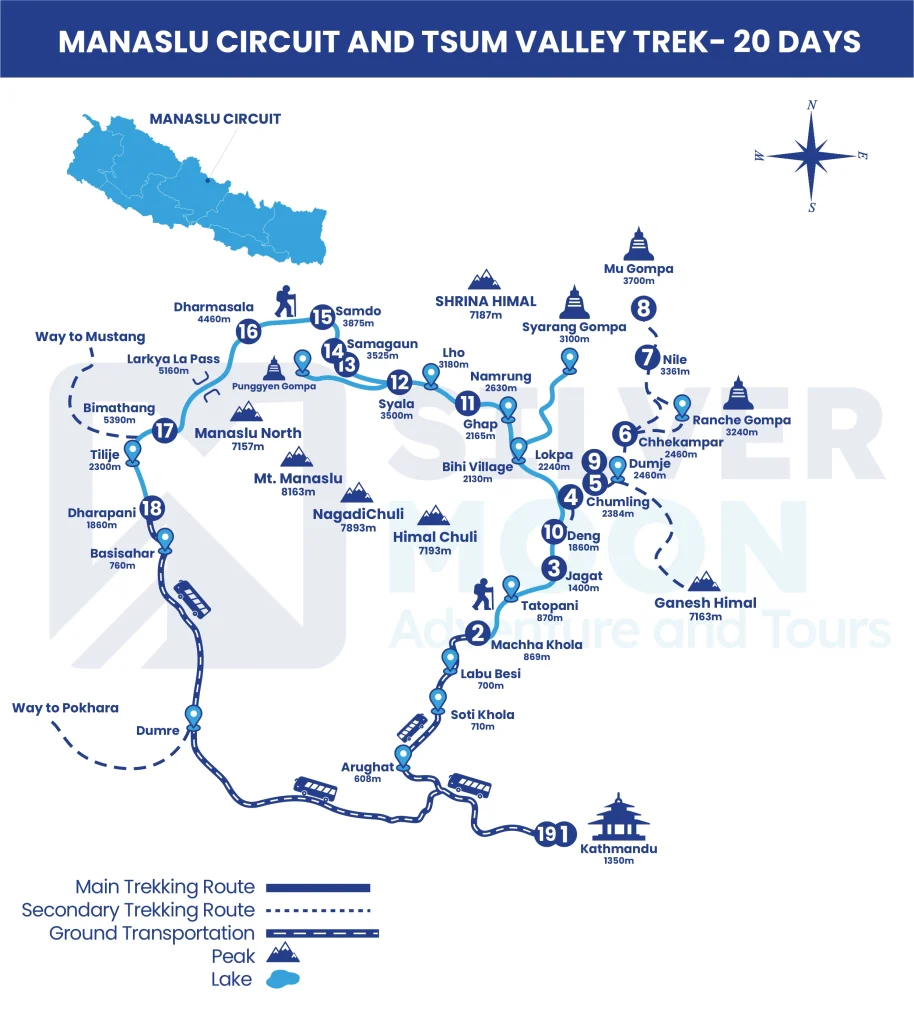
Altitude in:
Additional information
Trekking Permits and Restricted Area Requirements
The Manaslu and Tsum Valley region is a regulated trekking area, so you need several permits.
According to the current package information, the necessary permits include:
- Manaslu Restricted Area Permit
- Tsum Valley Restricted Area Permit
- Manaslu Conservation Area Permit
- Annapurna Conservation Area Permit
- Chumnubri Rural Municipality Permit
- TIMS or equivalent documentation where applicable
The package includes the required trekking permits and government/local fees.
Because this is a restricted trekking region, foreign trekkers must travel with a licensed guide rather than trekking independently. Your trekking agency typically handles permit arrangements before you enter the restricted sections.
Understanding the Trek Difficulty
This is a moderate to challenging trek, and the difficulty increases significantly as you move toward the higher sections of the Manaslu Circuit.
You should be comfortable walking for several hours on consecutive days, often over uneven terrain with frequent ascents and descents. The Larkya La crossing is the most demanding section, with a long trekking day that combines an early-morning ascent, high altitude, and a substantial descent toward Bimthang. The current itinerary estimates around 10–11 hours for this day.
Previous high-altitude trekking experience is useful, although proper physical preparation and a gradual pace are more important than simply having a long list of previous treks.
Physical Preparation
Start preparing several weeks before the trek. Since the route includes long walking days and reaches above 5,000 meters, basic fitness alone is not enough if you are not accustomed to extended hiking.
Useful preparation includes:
- Long-distance walking
- Stair climbing
- Uphill and downhill hiking
- Jogging or cycling
- Leg and core strengthening
- Weekend hikes with a backpack
- Practicing with your actual trekking boots
Pay particular attention to downhill walking. The descent after Larkya La can be tiring even after completing the climb.
Accommodation Along the Trail
Accommodation during the trek is provided in locally operated teahouses and mountain lodges, while the Kathmandu portions use a 3-star hotel according to the current itinerary.
Teahouses become simpler as you move higher and deeper into the restricted regions. You should expect basic rooms and shared facilities rather than hotel-style comfort.
The current FAQ describes the teahouses as simple but practical, providing shelter and warm meals rather than luxury accommodation.
Food and Drinking Water
The package includes breakfast, lunch, and dinner during the trekking section.
Typical teahouse meals include:
- Dal bhat
- Noodles
- Fried rice
- Soups
- Momos
- Potatoes
- Eggs
- Porridge
- Pancakes
- Tibetan bread
Vegetarian food is widely available along the route.
Carry a reusable water bottle and use treated, filtered, or properly purified water. The current trip notes specifically recommend carrying water purification tablets.
What to Pack
Because the trek covers a large range of elevations and climates, layering is important.
Recommended items include:
- Waterproof trekking boots
- Warm trekking socks
- Moisture-wicking base layers
- Fleece or warm mid-layer
- Down or insulated jacket
- Waterproof and windproof shell
- Waterproof trekking trousers
- Thermal leggings
- Warm hat and gloves
- Sunglasses with suitable UV protection
- Headlamp with spare batteries
- Trekking poles
- Reusable water bottles
- Sleeping bag
- Sunscreen and lip balm
- Personal medication
- Basic first-aid supplies
- Power bank
- Backpack rain cover
- Dry bags
- Personal toiletries
The current equipment list recommends a sleeping bag with a roughly -5°C to -10°C comfort rating, depending on conditions and season.
Porter and Baggage
A porter can make this long trek considerably easier, particularly during the high-altitude sections.
The current package lists porter service as an additional cost, with one porter for two trekkers.
Keep your daypack light and carry only what you need during the day’s walk. Your daypack should normally contain water, snacks, rain protection, warm layers, sunscreen, personal medication, documents, and electronics.
Electricity, Charging and Wi-Fi
Electricity is available in many villages, but charging facilities may become limited and can involve additional fees.
Wi-Fi and mobile connectivity are also less reliable in remote and high-altitude sections. The current trip notes specifically warn trekkers to expect limited internet and charging availability at higher elevations.
A power bank is strongly recommended. Keeping your phone in battery-saving mode can also help during long trekking days.
Money and Personal Expenses
Carry sufficient Nepalese cash for the entire trekking section.
Once you leave the main towns, ATM access becomes extremely limited, and most teahouses and local businesses operate on cash. The current FAQ also notes that prices for some services can increase at higher elevations because supplies are more difficult to transport.
Keep additional cash for:
- Hot showers
- Charging
- Wi-Fi
- Snacks
- Drinks
- Personal purchases
- Tips
- Unexpected expenses
The package excludes personal expenses, travel insurance, trekking equipment, hot showers, charging, Wi-Fi, beverages, and tips.
Travel Insurance and Emergency Support
Travel insurance is particularly important for this trek because of its remote location and high-altitude sections.
Your policy should cover high-altitude trekking, emergency medical treatment, and helicopter evacuation where required.
Before departure, carefully check the altitude limit and activities covered by your policy. Carry your insurance details and emergency contact information throughout the trek.
Weather and Trail Conditions
Weather can change quickly in the Manaslu region, particularly around Samdo, Dharamsala, and Larkya La.
The current page recommends spring from March to May and autumn from late September to November.
Spring can bring warmer conditions and blooming forests in the lower sections, while autumn generally follows the monsoon and can offer clear mountain views.
Winter is possible but becomes significantly more demanding because of cold temperatures and possible snow around the high pass. The current FAQ describes winter as a high-altitude challenge rather than a typical trekking experience.
Monsoon trekking can involve rain, muddy trails, landslides, and more difficult road access.
Respecting Buddhist Culture
Tsum Valley and the upper Manaslu region have strong Tibetan Buddhist traditions.
You will encounter monasteries, mani walls, prayer wheels, chortens, prayer flags, and other religious landmarks throughout the trek.
When visiting monasteries:
- Dress respectfully.
- Keep your voice low.
- Ask before taking photographs.
- Do not touch religious objects without permission.
- Follow local instructions.
- Walk around mani walls and religious structures rather than stepping over them.
The cultural experience is one of the most important parts of visiting Tsum Valley, so respectful behavior matters.
Wildlife and the Natural Environment
The route passes through forests, alpine meadows, river valleys, and protected landscapes. The changing environment provides habitat for a variety of Himalayan wildlife and birds.
Do not feed wildlife, leave food waste behind, or make unnecessary noise in forest areas.
Stay on established trails wherever possible and avoid damaging vegetation. Carry reusable bottles and minimize single-use plastic during the trek.
Responsible Trekking
Because the Manaslu and Tsum Valley route passes through remote communities, responsible tourism is especially important.
You can contribute positively by:
- Using local teahouses and shops.
- Respecting local customs.
- Reducing plastic waste.
- Carrying your rubbish to proper disposal points.
- Using water responsibly.
- Avoiding unnecessary noise.
- Respecting private homes and farmland.
- Supporting local guides and porters.
The route’s remote nature means even small environmental impacts can remain visible for a long time.
Photography and Battery Management
The trek offers enormous variety for photography, from lush river valleys and suspension bridges to Tibetan Buddhist villages, monasteries, glaciers, high mountain passes, and views of Manaslu.
Some of the most memorable locations include:
- Tsum Valley
- Chumling
- Chekampar
- Mu Gompa
- Shyala
- Samagaon
- Birendra Lake
- Manaslu Base Camp
- Samdo
- Larkya La
- Bimthang
Cold temperatures can reduce battery performance, especially at higher camps. Carry a power bank and protect batteries from extreme cold when possible.
Tipping Guides and Porters
Tipping is not mandatory, but it is a common way to show appreciation to the trekking team.
If you are satisfied with your guide and porter’s service, you can offer a tip at the end of the trek. The amount can depend on the trek length, quality of service, group size, and your personal budget.
It is generally best to give the tip directly and thank the team personally.
Road Travel and Itinerary Flexibility
The Manaslu and Tsum Valley Trek involves significant road travel at both ends of the journey.
The road to Machha Khola can be rough, while the return from Dharapani to Kathmandu is another long mountain journey. The current FAQ notes that road conditions can remain rough and travel times may vary.
Weather, road conditions, trail conditions, health, and accommodation availability can all affect the schedule. The Mu Gompa overnight, for example, depends on weather and accommodation availability.
For this reason, avoid scheduling an international flight immediately after a long mountain-road journey if possible.
Who Is This Trek Suitable For?
The Manaslu Circuit and Tsum Valley Trek is suitable for trekkers who are comfortable with remote trails, basic teahouse facilities, long walking days, and high-altitude terrain.
It can be a good fit if you want to experience:
- A less-developed Himalayan trekking region
- Tibetan Buddhist culture
- Remote mountain villages
- Tsum Valley
- Mu Gompa
- Manaslu Base Camp
- Birendra Lake
- High Himalayan landscapes
- Larkya La Pass
- A longer and more varied trekking experience
The current page describes the trek as moderate to challenging and notes that trekkers should be prepared for basic facilities and high-altitude conditions.
Best Time for the Trek
The main recommended trekking periods are spring, from March to May, and autumn, from late September to November.
Autumn can provide clear mountain views after the monsoon, while spring offers warmer conditions and blooming vegetation in the lower sections.
Winter requires more preparation because of cold and possible snow around Larkya La. Monsoon conditions can make both the trekking trail and access roads more difficult.
A Few Things to Keep in Mind
The Manaslu Circuit and Tsum Valley Trek is a long journey, and its appeal comes from the gradual change in landscape and culture rather than a single destination.
You begin among green hills and river valleys, enter the quiet Buddhist communities of Tsum Valley, reach the high alpine landscape around Samagaon and Samdo, cross the demanding Larkya La Pass, and finally descend through forests toward Dharapani.
Prepare properly, keep your walking pace steady, respect altitude, and remain flexible when mountain conditions require changes.
Most importantly, allow yourself time to appreciate the quieter parts of the journey; the monasteries, villages, prayer flags, mountain landscapes, and conversations with local people. These experiences are just as important as reaching the high pass.
FAQs for this trip
General Questions
-
What makes the Manaslu Circuit with Tsum Valley Trek special?
This trek combines two of Nepal’s most remarkable trekking regions into one adventure. You experience the remote wilderness of the Manaslu Circuit alongside the hidden Buddhist culture, ancient monasteries, and untouched landscapes of Tsum Valley.
-
Is this trek suitable for people looking for an off-the-beaten-path experience?
Yes. Compared to Nepal’s more famous trekking routes, Manaslu and Tsum Valley offer a quieter atmosphere, fewer crowds, and a stronger sense of exploration.
-
How long should I plan for the trek?
The Manaslu and Tsum Valley Trek usually takes 17 to 22 days. The exact duration depends on your walking pace, the number of acclimatization days, and whether you include extra time for exploring Tsum Valley.
-
Why do many trekkers add Tsum Valley to the Manaslu Circuit?
Tsum Valley provides a completely different experience from the main circuit, with unique cultural traditions, sacred sites, and villages influenced by Tibetan Buddhism.
-
Is this trek suitable for nature lovers?
Absolutely. The trek passes through diverse landscapes, including forests, river valleys, alpine meadows, glaciers, and high mountain terrain. Along the way, you may also have chances to see Himalayan wildlife.
Trekking Challenge and Physical Preparation
-
How demanding is the Manaslu and Tsum Valley Trek?
The trek is considered moderate to challenging because of its length, high altitude, and long walking days. The biggest challenge is crossing the 5,106-meter Larkya La Pass, which requires good fitness and proper acclimatization.
-
Which section is considered the most difficult?
The trek’s most challenging part is the crossing of the Larkya La Pass. This particular section starts in Dharamsala (4,460m), climbs to the summit of Larkya La (5,106m), and then descends sharply to Bhimthang (3,590m).
-
How fit do I need to be?
You must have a high level of cardiovascular endurance and strong lower-body strength, similar to running a half-marathon or hiking uphill for hours with a heavy pack.
You do not need to be an exceptional athlete, but you must train consistently for at least 3 to 4 months before the trip.
-
How many kilometers do trekkers usually walk each day?
Depending on the terrain and route, each day typically consists of 10 to 18 kilometers of walking. Even though the distances aren’t long, the steep, rough routes can make the journey more strenuous and time-consuming.
-
Is prior high-altitude trekking experience necessary?
No. However, previous hiking experience can make the trek more enjoyable and manageable.
High Altitude and Trekking Safety
-
What is the highest elevation reached during the trek?
The Larkya La Pass, at 5,106 meters (16,752 feet), is the highest elevation reached during the climb. This mountain is often reached on the day of the crossing from Dharamsala to Bhimthang.
-
Is altitude sickness a concern on this route?
Yes. Any trek above 3,000 meters carries a risk of altitude-related illness. Also, you spend many consecutive days over 3,500 meters and traverse a pass higher than 5,100 meters.
-
How can I reduce the risk of altitude sickness?
You must adhere to the guidelines for progressive acclimatization, adequate hydration, and self-monitoring to lower your risk of altitude sickness.
When walking at high altitudes, the golden rule is to “climb high, sleep low, and walk slowly.”
-
Are medical facilities available along the trail?
Along the Manaslu and Tsum Valley trek, there are very few, rudimentary, and widely dispersed medical services. There are no cutting-edge trauma centers or hospitals along the route.
The majority of communities have only basic government health posts with very few medical supplies intended for locals.
-
Can emergency rescues be arranged if necessary?
Yes. Helicopter evacuation services can be organized in emergencies when weather conditions permit. But prevention and early detection are crucial since the Manaslu and Tsum Valley climb is more isolated than Everest or Annapurna, and evacuation logistics may take longer.
Exploring Tsum Valley
-
Why is Tsum Valley often called the Hidden Valley?
Tsum Valley’s unusual physical seclusion, preservation of old Tibetan culture, and history of being cut off from the outside world have earned it the moniker “Hidden Valley” (traditionally referred to as a Beyul in Buddhist literature).
-
What is the cultural significance of the Tsum Valley?
Its cultural landscape is distinguished by its status as a sacred sanctuary where nonviolence is legally and spiritually enforced.
Tsum Valley is a living museum of ancient Tibetan Buddhism, where centuries-old customs, spiritual guidelines, Buddhist monasteries, prayer walls, sacred caves, and way of life are completely unaffected by contemporary influences.
-
Which monasteries are the most famous in Tsum Valley?
The two most well-known monasteries in Tsum Valley are Mu Gompa (3,700m) and Rachen Gompa (3,240m). These locations, together with the holy Piren Phu cave (Milarepa’s Cave), establish the spiritual center of the area and are the main cultural tourist attraction.
-
Can I interact with local communities during the trek?
Indeed, one of the main highlights of this journey is connecting with local people. Your interactions with people will seem incredibly genuine and kind, since the Manaslu and Tsum Valley itineraries are less commercialized than those in other areas. You will get the opportunities to learn about local lifestyles, customs, and traditions.
-
Is Tsum Valley different from the rest of the Manaslu Circuit?
Very much so. While the Manaslu Circuit focuses on mountain scenery and high passes, Tsum Valley offers a deeper cultural and spiritual experience.
Highlights of the Manaslu Region
-
What mountain dominates the trek?
The majestic Mount Manaslu entirely dominates this hike. It is the eighth-highest peak in the world, rising 8,163 meters (26,781 ft) above sea level. It is named after the Sanskrit term Manasa, meaning “Mountain of the Spirit.”
-
Are there opportunities for side hikes?
Yes, some of Nepal’s most breathtaking side treks may be found on the Manaslu and Tsum Valley Trek. Before you cross the Larkya La Pass, these day treks are essential for acclimatization, helping your body adjust to the thinner air.
Popular side trips include Manaslu Base Camp (4,400m), Pungen Gompa (4,050m), Mu Gompa, and various local viewpoints.
-
What is Larkya La Pass known for?
Larkya La Pass is best known as the highest and most physically demanding point on the Manaslu Circuit Trek, at 5,106 m.
Besides, the highest pass offers the most dramatic mountain views in the Himalayas, including Cheo Himal (6,812m), Kang Guru (6,981m), Gyaji Kang (7,074m), and Annapurna II (7,937m).
Best Seasons for the Trek
-
When do most people trek in Manaslu and Tsum Valley?
Spring and autumn are the most popular seasons due to favorable weather and excellent mountain visibility.
-
What are the advantages of trekking in spring?
Trekking in the springtime brings brighter flowering rhododendron woods, milder temperatures, and fewer visitors. You may visit a busy climber’s tent city at Manaslu Base Camp and observe lively mountain wildlife along the trail.
-
Why is autumn considered peak season?
Autumn is the best time of year, since the monsoon rains have just ended, leaving behind the most consistent weather, beautiful blue skies, and unmatched, sharp mountain vistas.
Also, this season is the safest for crossing Larkya La Pass because the weather is more stable and there’s less chance of sudden snow or storms. Mornings are usually clear, with better visibility than in spring when clouds often build up later in the day.
-
Can the trek be completed during winter?
It is possible to finish the walk in winter (December to February), but it becomes a challenging high-altitude adventure rather than a typical trek.
Only very experienced trekkers who are ready for extremely cold temperatures are advised to do this.
-
What should I expect during the monsoon season?
During the rainy season (June to August), trekking the Manaslu and Tsum Valley circuit becomes a very unexpected, dirty, and difficult trip.
You must be ready for significant safety risks and bodily discomfort as the scenery shifts to an exquisitely lush, green paradise full of cascading waterfalls.
Accommodation and Meals
-
What kind of lodging is available?
There are only locally operated teahouses (small mountain lodges) available for lodging along the Manaslu and Tsum Valley journey. As you ascend higher, these provide a surprisingly genuine yet increasingly primitive experience.
-
Are tea houses comfortable?
Teahouses are simple but comfortable places to stay. They provide basic shelter and warm meals rather than luxury.
If you only expect a dry bed and good food, they can be very satisfying, but they are not comparable to regular hotels.
-
Is electricity available during the trek?
Yes. Almost all villages have access to electricity, though charging devices often involves an additional fee.
-
What meals can I expect?
Teahouses typically serve dishes like dal bhat, noodles, fried rice, soups, momos, potatoes, eggs, porridge, pancakes, and Tibetan bread.
Most teahouses offer very similar menus, featuring a wide range of dishes common throughout the trekking region.
-
Are vegetarian meals easy to find?
Yes. Yes, vegetarian meals are widely available and are often the most common option along the trek. You won’t have any issue getting substantial, varied vegetarian cuisine at every single teahouse due to local culture and remote logistics.
Permits, Guides, and Regulations
-
Is a permit required for the Manaslu and Tsum Valley Trek?
Yes, to officially complete the combined Manaslu and Tsum Valley Trek, you need five different permits. Both valleys are highly regulated and restricted areas due to their proximity to Tibet.
- Manaslu Restricted Area Permit
- Tsum Valley Restricted Area Permit
- Manaslu Conservation Area Permit (MCAP)
- Annapurna Conservation Area Permit (ACAP)
- Chumnubri Rural Municipality Permit
-
Can I trek without a guide?
No, you cannot legally trek without a guide. The trail falls under a restricted area, and foreign trekkers must be accompanied by a licensed guide throughout the trek, per Nepalese rules.
-
Why is the area restricted?
The Manaslu and Tsum Valley regions are designated as restricted zones by the Nepali government for three main reasons: environmental protection, cultural preservation, and border security.
-
Do solo travelers need to join a group?
You no longer need to join a group for the Manaslu and Tsum Valley trek. Solo travelers can now get the required permits through a registered agency.
However, a licensed guide is still mandatory, as independent trekking is not allowed in this restricted region.
-
Are permit costs included in trekking packages?
Yes, Permit fees are usually included in full-board trekking packages. Since special permits are required for Manaslu and Tsum Valley, trekking agencies typically arrange them and include them in the cost. Still, check the package details to confirm what’s included.
Transportation and Route
-
Where does the trek begin?
The trek usually starts from Machha Khola (about 930m). It is a small village by the river in the Gorkha district.
-
How long is the drive from Kathmandu?
The drive from Kathmandu to Machha Khola takes about 7–9 hours. Although it’s only about 160 km, rough, unpaved roads through narrow river valleys make the journey slower.
-
Can I finish the trek in a different location?
Yes, the trek ends in a different place from where it starts. Since the Manaslu Circuit is a loop with a high pass crossing, you don’t return to the starting point. It typically finishes in Dharapani or Besisahar in the Annapurna region.
-
Is the road journey comfortable?
Road conditions have improved in recent years, but some sections remain rough and bumpy.
-
Do trekkers return through Tsum Valley?
No, trekkers don’t return through Tsum Valley. It’s usually done as an out-and-back side trip before rejoining the main Manaslu Circuit route and continuing the loop.
Budget and Expenses
-
Is this trek more expensive than other tea-house treks?
Yes, the Manaslu and Tsum Valley Trek generally costs more than the Annapurna Circuit or Langtang Valley treks.
Food and accommodation prices are similar, but the required permits, guide services, and the remote location make the overall trek more expensive.
-
Should I carry cash during the trek?
Yes, you need to carry enough cash for the entire trek. Once you leave the main towns, there are no ATMs, and teahouses only accept cash in Nepali rupees.
Some teahouses do accept online payments, but it can be a hurdle with slow internet.
-
Can I use credit cards in mountain villages?
No. Most tea houses and local businesses accept only cash.
-
What additional expenses should I budget for?
Beyond your main trekking package, you should budget extra for daily teahouse services such as hot showers, device charging, and Wi-Fi, which can add $5–$10 per day.
You’ll also need cash for snacks, drinks, and other personal items on the trail, as well as pre-trip costs like the Nepal visa and travel insurance.
-
Do prices increase as you gain altitude?
Yes, prices go up as you gain altitude because supplies have to be carried in by porters, mules, or yaks, making transportation difficult and expensive.
Common Questions from First-Time Visitors
-
Is the Manaslu Circuit with Tsum Valley suitable for first-time visitors to Nepal?
Yes, but only if you are very fit, adaptable, and prepared for a remote and rugged trek.
While many first-time trekkers choose easier or more developed routes, it is still possible to do the Manaslu and Tsum Valley trek with proper preparation.
-
What surprises most trekkers about this route?
A common surprise on this trek is how quickly the scenery and culture change, from hot, humid lowlands to cold, high mountain landscapes within a few days. Many trekkers don’t expect the early heat or the long suspension bridges over deep river valleys.
The trail is quiet and remote, especially in Tsum Valley, which has a peaceful atmosphere. As you gain altitude, you’ll see the culture change from Hindu villages to Tibetan Buddhist communities, adding a unique experience to the trek.
-
Is the trek more about culture or mountains?
The Manaslu and Tsum Valley Trek offers a mix of mountain scenery and cultural experiences.
It combines high Himalayan landscapes with visits to remote traditional villages, giving a balance of nature and culture throughout the journey.
-
Who would enjoy this trek the most?
This trek is best for experienced hikers who want remote, less-crowded Himalayan trails with a tough high-altitude pass crossing.
It also suits those interested in Tibetan Buddhist culture in the isolated Tsum Valley. It requires comfort with basic accommodation and simple trekking conditions.
-
Why is the Manaslu Circuit with Tsum Valley considered one of Nepal’s hidden gems?
The Manaslu Circuit with Tsum Valley is often called a hidden gem because it is less crowded and more remote than the Everest or Annapurna regions. It offers big Himalayan views, including the challenging Larkya La Pass (5,106m), along with a peaceful trek through quiet trails.
Tsum Valley is a cultural highlight, featuring traditional Tibetan Buddhist villages and well-preserved heritage. The route feels authentic and less commercial, with simple family-run teahouses along the trail.


USD 1,190PP
Why book with us?
- Local Guides & Porters
- 98% Success Trip Rate
- Comfort Priority and Saftey Trip
- Satisfied Client
-
Group Size Discounts
Discounts are solely based on your group size. We don’t add anyone to the group.
No. of people Price per person 1 pax USD 1580 2-4 pax USD 1280 5-10 pax USD 1160 11+ pax USD 1150
Send Quick Email
Similar trips
View all trips
Ama Yangri Trek
Explore Ama Yangri, sacred caves, Sherpa culture, and Melamchi’s hidden Himalayan beauty.
Makalu Base Camp Trek – 20 Days
Explore the Makalu Base Camp Trek in Nepal with our 20-day Himalayan adventure package.
Royal Trek Nepal – 10 Day Trekking Package
Explore Royal Trek Nepal with Himalayan scenery, cultural sightseeing, and authentic village experiences.