Mountain Views During Everest Base Camp Trek
Share:
 Read Time
This blog has 2227 words .This blog has 14191 characters.This blog take 7 minutes to read.
What if the best mountain view on the Everest Base Camp Trek is not the one you expected?
Most people begin the journey with one mountain in mind: Everest.
That makes sense. Mount Everest is the reason the route has become one of Nepal’s most famous trekking journeys. But once you actually start walking through the Khumbu, something surprising happens. Everest is only one part of the scenery.
The trail gradually moves from river valleys and green forests toward high alpine landscapes, where peaks such as Thamserku, Kangtega, Ama Dablam, Lhotse, Nuptse and Pumori begin appearing around you. Nepal Tourism Board describes the route above Namche as having spectacular views of Thamserku, Kangtega and Ama Dablam, with Everest and Lhotse dominating the skyline ahead.
And the higher you walk, the more the landscape changes.
So what mountains can you actually see during the trek, and where are the views that are worth slowing down for?
The Mountain Views Start Before Everest Appears
One of the interesting things about the Everest Base Camp Trek is that you do not spend the entire journey staring directly at Everest.
The early section around Lukla and Phakding is greener and more sheltered. The trail follows the Dudh Koshi valley, passing forests, suspension bridges and villages before gradually gaining elevation toward Namche Bazaar. Nepal Tourism Board describes this lower section as a journey through the Dudh Koshi valley toward the Sherpa settlement of Namche.
At this stage, the mountains may appear between trees or above the valley rather than filling your entire field of vision.
That gradual change is part of what makes the trek interesting.
You are not simply transported into a giant mountain photograph.
You slowly walk into it.
Namche Bazaar: When the Himalayas Start Feeling Real
Namche Bazaar is often the point where trekkers begin to realize that this is going to be much more than a normal hike.
The town sits at around 3,500 metres and acts as an important acclimatization point on the Everest route. From the surrounding viewpoints and trails, the mountain landscape begins opening considerably.
From here, you can begin seeing peaks such as Thamserku and Kangtega, while the larger mountains of the Khumbu start dominating the horizon.
For many trekkers, this is also when the question changes from:
“Will I reach Everest Base Camp?”
to:
“How many mountains am I actually looking at?”
And you will ask that question repeatedly.
Thamserku and Kangtega: The Mountains You Might Not Expect
When people search for the mountains seen on Everest Base Camp Trek, they often search only for Everest.
But Thamserku and Kangtega deserve attention too.
Thamserku rises dramatically above the Khumbu landscape, while Kangtega forms another striking part of the skyline as you move beyond Namche. Nepal Tourism Board specifically identifies both peaks among the prominent mountain views along the trail toward Tengboche.
Their appearance also helps show how the scenery changes as you move deeper into the region.
Instead of seeing one isolated mountain, you begin to experience the Himalayas as a huge landscape of overlapping ridges, valleys, glaciers and peaks.
And then comes the mountain that tends to steal everyone’s attention.
Ama Dablam: The Mountain That Doesn’t Need an Introduction
If Everest is the most famous mountain on the trek, Ama Dablam may be the one that surprises you the most.
Its distinctive shape makes it easy to recognize, and it becomes an important visual landmark as you move through the Khumbu.
Tengboche is particularly memorable because the monastery sits in a spectacular setting with Ama Dablam forming the backdrop. Nepal Tourism Board describes Tengboche as having panoramic views of Everest, Lhotse and Ama Dablam, while its monastery is particularly known for its dramatic Ama Dablam backdrop.
This is one of those places where you may plan to stop for five minutes and somehow still be standing there twenty minutes later.
Nobody really complains about that kind of delay.
Everest and Lhotse Begin Taking Over the Horizon
As the trail continues beyond Tengboche toward Pangboche, Dingboche and the higher Khumbu, the landscape becomes increasingly dominated by enormous Himalayan peaks.
Everest becomes more prominent, while Lhotse rises beside it.
Lhotse is the fourth-highest mountain in the world at 8,516 metres and is connected to Everest by the South Col.
From the trekking route, Everest and Lhotse can appear almost as a pair on the horizon, although their shapes and positions become more recognizable as you gain elevation.
This is also where the environment begins changing noticeably. Forests gradually give way to alpine vegetation, rocky terrain and increasingly barren landscapes. Nepal Tourism Board notes that vegetation in Sagarmatha National Park changes from forests and rhododendrons toward alpine plants and eventually bare rock and snow as altitude increases.
The mountains do not simply become bigger.
The entire world around you becomes different.
Dingboche: A Wider Himalayan Landscape
Dingboche is another important point for appreciating the changing Everest Base Camp scenery.
At this elevation, the landscape feels much more open. Instead of looking through forests toward distant peaks, you begin walking through a broad high-altitude environment surrounded by enormous mountains.
This is also where acclimatization becomes particularly important. A properly structured Everest itinerary includes time for the body to adjust rather than treating every day as a race toward Base Camp.
For example, Silver Moon’s Everest Base Camp itinerary includes an acclimatization day at Dingboche before continuing toward Lobuche and the higher Khumbu. Its itinerary also includes an optional hike toward Nangkartsang Peak on the acclimatization day.
That extra time can be useful not only for acclimatization but also for actually appreciating where you are.
Because once you reach the high mountains, rushing through the scenery would be a little like visiting a cinema and spending the entire movie looking at the exit sign.
Nuptse and Pumori Enter the Picture
As you approach Lobuche and Gorak Shep, the scenery becomes much more rugged.
You are now surrounded by glaciers, rocky terrain and enormous walls of mountain.
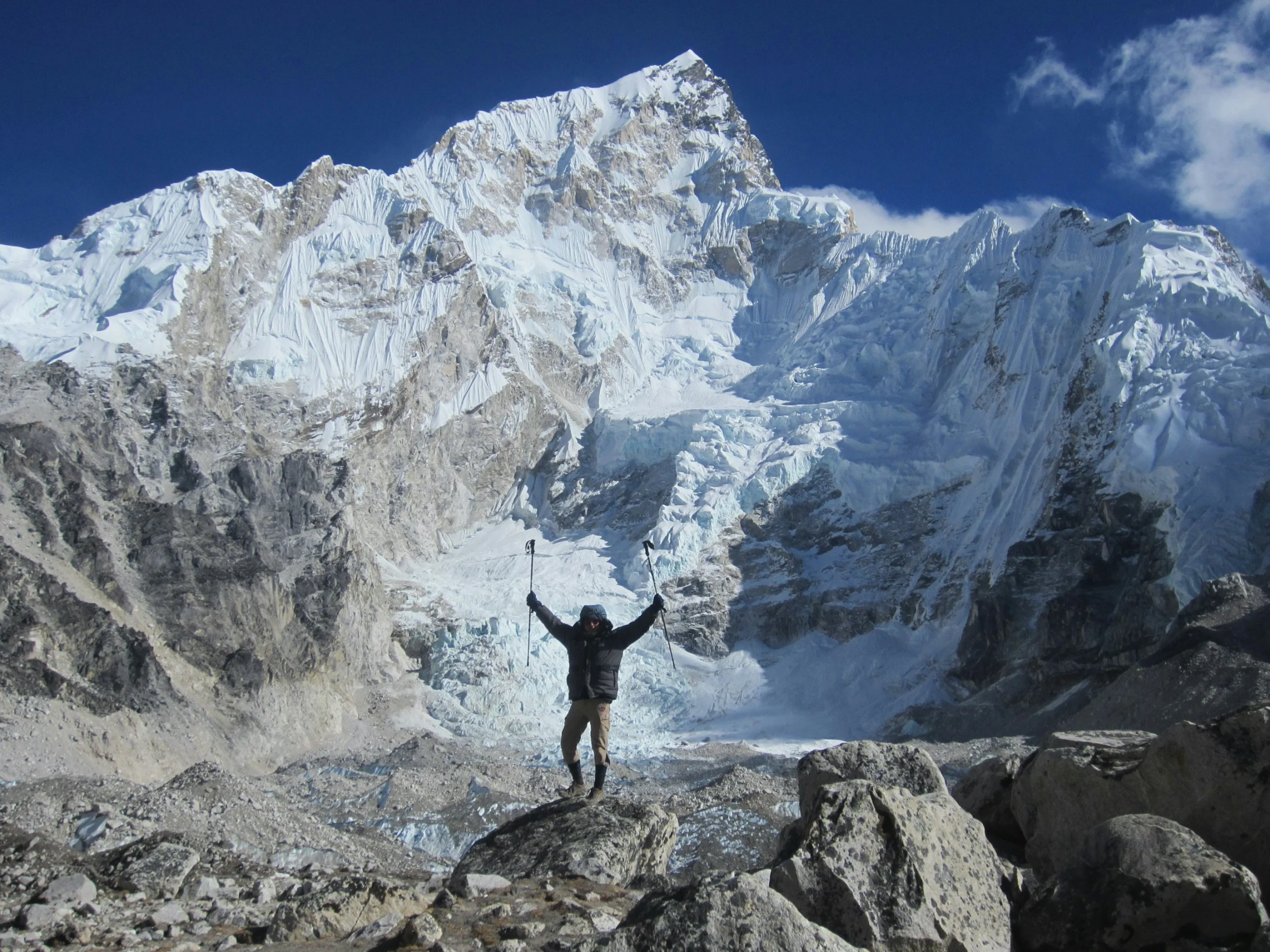
Nuptse becomes an important part of the landscape around the Everest Base Camp area, while Pumori rises prominently near the upper Khumbu.
These mountains contribute to the feeling that you are no longer simply trekking toward a mountain.
You are inside a mountain landscape.
The difference is important.
Earlier in the trek, you may stop because you can see a beautiful peak in the distance. Higher up, you may stop simply because there are mountains in almost every direction.
Everest Base Camp: Is Everest Actually the Best View Here?
Here is something many first-time trekkers do not realize.
Everest Base Camp itself is not necessarily the place for the classic panoramic Everest photograph.
The Base Camp area is famous because of what it represents: the starting point for expeditions attempting Everest and a dramatic destination surrounded by the Khumbu Glacier and enormous mountain terrain.
For the broadest classic view of Everest, trekkers commonly continue to Kala Patthar.
Nepal Tourism Board specifically identifies Kala Patthar as a famous viewpoint known for outstanding views of Everest.
So if your main goal is to photograph Everest, do not think of Base Camp as the end of the story.
There is another viewpoint waiting.
Kala Patthar: The View Many Trekkers Remember Most
Kala Patthar is often considered one of the defining viewpoints of the Everest Base Camp Trek.
The early-morning climb can be cold, dark and physically demanding. You may question several life decisions somewhere between putting on your boots and reaching the viewpoint.
Then the sky begins to brighten.
Everest, Nuptse, Pumori and the surrounding peaks begin catching the first light.
And suddenly you understand why people wake up ridiculously early in freezing temperatures to climb a hill.
Nepal Tourism Board lists Kala Patthar at approximately 5,545 metres and highlights it for its outstanding views of Mount Everest.
For photographers, this is one of the most important sections of the entire journey because the changing light can completely alter the appearance of the mountains.
The same peaks that looked grey and distant in the afternoon can appear golden and sharply defined during sunrise.
Does the Weather Affect the Mountain Views?
Absolutely.
Even when you have chosen the right season, Himalayan weather can change quickly, and clouds can hide peaks that were perfectly visible a few hours earlier.
This is why mountain viewing on the Everest Base Camp Trek is partly about timing.
Morning conditions are often important for photographers and trekkers hoping for clearer mountain views, although weather is never something that can be guaranteed.
That uncertainty is also part of the experience.
You may spend an entire day waiting for a mountain to appear through the clouds.
Then, for thirty seconds, the clouds open.
And there it is.
You take the photograph.
The clouds return.
Congratulations. The Himalayas have just taught you patience.
Which Mountains Can You See on the Everest Base Camp Trek?
The exact visibility depends on location, weather and trail conditions, but major peaks and mountain landscapes encountered along the route include:
- Mount Everest
- Lhotse
- Nuptse
- Ama Dablam
- Thamserku
- Kangtega
- Pumori
- Khumbila
- Cho Oyu, particularly on extended routes toward Gokyo
The Nepal Tourism Board identifies Everest, Lhotse, Cho Oyu and numerous other peaks above 6,000 metres within the Everest region.
Trekkers who combine Everest Base Camp with Gokyo can experience an even broader mountain panorama. Nepal Tourism Board notes that Gokyo offers views extending from Everest and Lhotse toward Makalu, as well as views of Cho Oyu from the valley and Gokyo Ri.
The Best Part Is That the Views Keep Changing
The real beauty of the Mountain Views During Everest Base Camp Trek is not one single viewpoint.
It is the progression.
You begin among forests and river valleys.
Then the first peaks appear.
Namche opens the horizon.
Ama Dablam becomes a constant presence.
Everest and Lhotse become increasingly dominant.
The forests disappear.
Glaciers and rocky valleys replace them.
Finally, from the high viewpoints around Gorak Shep and Kala Patthar, the mountains seem to surround you completely.
That progression is what makes the Everest Base Camp Trek different from simply taking a mountain flight or visiting a viewpoint.
You do not just see the Himalayas.
You spend days walking toward them, watching them change with every valley, ridge and rise in altitude.
Why Choose Silver Moon Adventure?
Silver Moon Adventure organizes Everest trekking itineraries that combine the classic route with acclimatization, local trekking support and opportunities to experience the major landscapes of the Khumbu. Its current Everest Base Camp itinerary includes Namche, Tengboche, Dingboche, Lobuche, Everest Base Camp and Kala Patthar.
You can also explore the Everest Base Camp Trek to see the complete itinerary, inclusions and trekking information before planning your journey.
In Summary
The Mountain Views During Everest Base Camp Trek are much more than a single photograph of Mount Everest.
You see the landscape change from green valleys to alpine terrain and finally to the raw glacier-and-rock environment of the high Himalayas. Along the way, mountains such as Thamserku, Kangtega, Ama Dablam, Lhotse, Nuptse and Pumori gradually become part of the journey, while Kala Patthar provides one of the most memorable perspectives toward Everest.
And perhaps that is the most interesting thing about the trek.
You start by looking for Everest.
By the end, you realize you were surrounded by an entire Himalayan world.
FAQs About Mountain Views During Everest Base Camp Trek
1. Which mountains can I see during the Everest Base Camp Trek?
Major peaks include Mount Everest, Lhotse, Nuptse, Ama Dablam, Thamserku, Kangtega and Pumori. The exact views depend on your location and weather conditions.
2. Can you see Mount Everest from Everest Base Camp?
Everest is part of the surrounding mountain landscape, but the classic broad view of Everest is generally associated with viewpoints such as Kala Patthar rather than the Base Camp area itself.
3. Is Ama Dablam visible during the Everest Base Camp Trek?
Yes. Ama Dablam becomes a prominent part of the scenery after Namche, with particularly impressive views around Tengboche and the surrounding trail.
4. Where is the best view of Mount Everest during the trek?
Kala Patthar is one of the most famous viewpoints for seeing and photographing Everest. Nepal Tourism Board specifically highlights it for its outstanding Everest views.
5. Can I see Everest and Lhotse together?
Yes. Sections of the trail above Namche provide views toward both Everest and Lhotse, depending on the exact location and visibility.
6. Is Kala Patthar worth visiting for mountain views?
For trekkers interested in panoramic Himalayan scenery and Everest photography, Kala Patthar is one of the major viewpoints on the route.
7. Does weather affect Everest mountain views?
Yes. Clouds, snowfall, haze and changing mountain weather can significantly affect visibility, so clear views cannot be guaranteed on any particular day.
8. Are the mountain views better in the morning?
Early morning can provide excellent visibility and dramatic light, particularly around viewpoints such as Kala Patthar, although conditions vary from day to day.
9. Can I see more mountains by adding Gokyo to the Everest trek?
Yes. The Gokyo region offers additional mountain panoramas, including views toward Cho Oyu, Everest, Lhotse and Makalu.
10. What makes Everest Base Camp Trek scenery different from a mountain flight?
A mountain flight gives you an aerial view of the Himalayas in a short period, while trekking allows you to experience the landscape gradually as forests, valleys, glaciers and high mountains change around you.

Similar Blogs
View all
13/10/2026
Manaslu Circuit Trek After the October 2026 Floods: Trail Conditions, Safety and Travel Updates
The Manaslu Circuit Trek is one of Nepal’s most rewarding Himalayan journeys, taking trekkers through traditional...
Read more
13/10/2026
Your Nepal Trek Is Booked, but the Trail Is Closed: What Now?
Imagine arriving in Nepal with your trekking boots ready, your flights booked, your bags packed, and...
Read more