What If It Snowed in Kathmandu? Imagining the Valley in White
Share:
 Read Time
This blog has 3569 words .This blog has 23759 characters.This blog take 12 minutes to read.
Imagine waking up one winter morning, opening your hotel window, and discovering that Kathmandu has turned white overnight. Snow rests on the rooftops, the streets look unfamiliar, and the hills surrounding the valley disappear behind a soft layer of mist. Instead of the usual sounds of traffic, horns and busy market streets, you hear the footsteps of people stepping outside to see something they never expected.
For a moment, you might wonder whether you are still in Kathmandu.
The city is known for its ancient temples, red-brick courtyards, colourful prayer flags and lively streets. Snowfall in Kathmandu is rare, which makes the idea of seeing its historic landmarks covered in white so fascinating. What would Boudhanath look like beneath a snowy sky? Would Swayambhunath offer a completely different view of the valley? And how would the narrow streets of Patan and Bhaktapur look if snow settled between their traditional buildings?
This is an imaginary journey through Kathmandu Valley, where familiar landmarks appear in an entirely different atmosphere. The snowy scenes described here are fictional AI-generated visualizations, not photographs of actual snowfall at these locations. Kathmandu has experienced significant snowfall in the past, including an event in January 1945, but the scenes in this article are created to explore what such a transformation might look like today.
So, let us imagine what the valley might look like if winter returned with enough snow to transform its streets, temples and rooftops.
Kathmandu Durbar Square: History Under a Blanket of Snow
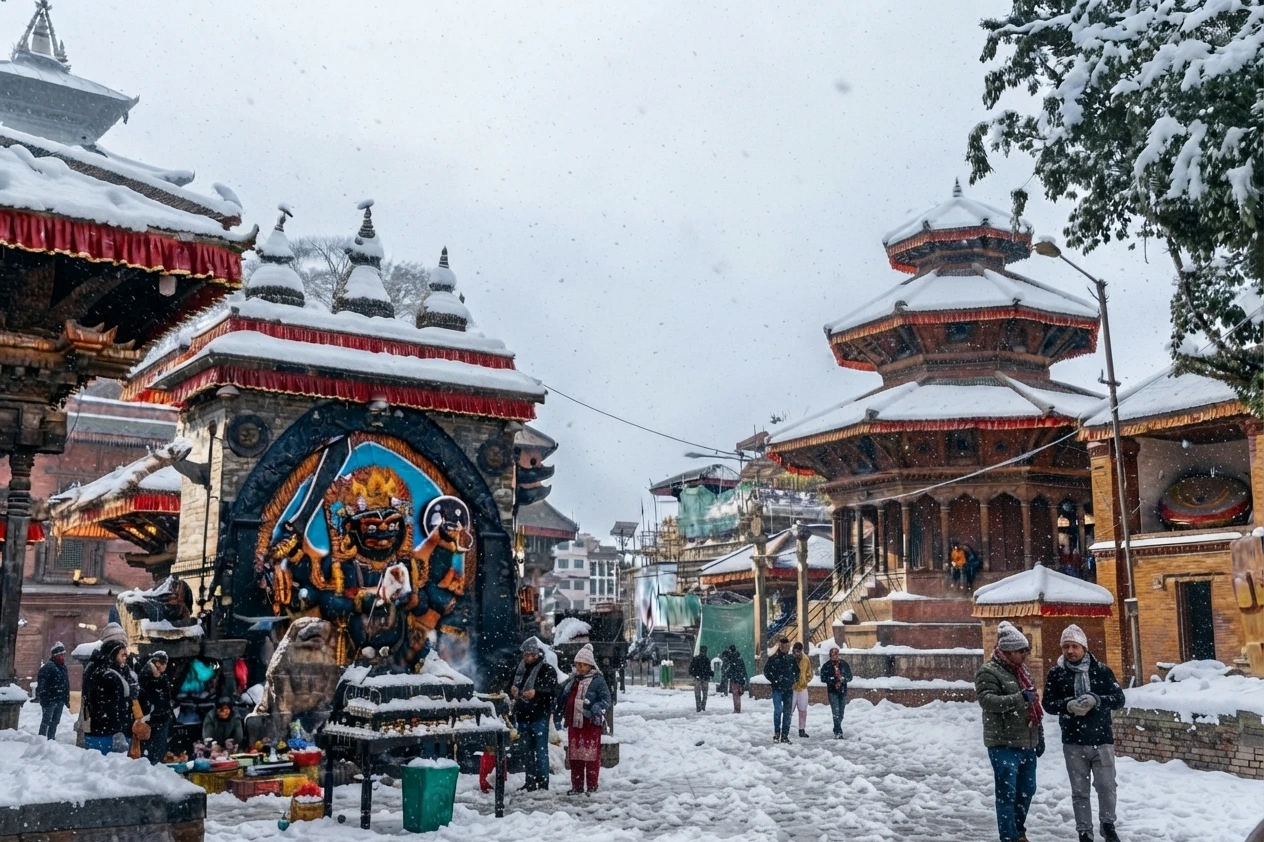
Imagine beginning your morning at Kathmandu Durbar Square, one of the valley’s most recognisable historic landmarks. You enter the old square and find its familiar red-brick buildings and traditional pagoda temples covered with a thin layer of snow. The dark wooden carvings stand out against the white rooftops, while the stone courtyard reflects the pale winter sky.
The square already feels like a place where time moves differently. Its historic courtyards, carved windows, temples and palace buildings carry stories from earlier centuries. Under snow, those details might appear even more dramatic, almost as though the city had stepped into a historical painting.
Picture yourself walking past the temples with a camera in your hand, trying to capture the contrast between the white rooftops and the deep colours of the old buildings. Every corner seems to offer another photograph. Even familiar structures look different when the landscape around them changes.
But Kathmandu Durbar Square would not lose its identity beneath the snow. Its traditional architecture, historic monuments and connection to the city’s cultural life would remain the most interesting parts of the experience.
That is what makes this imagined scene so appealing. Snow would change the appearance of the square, but the history behind its buildings would still be there.
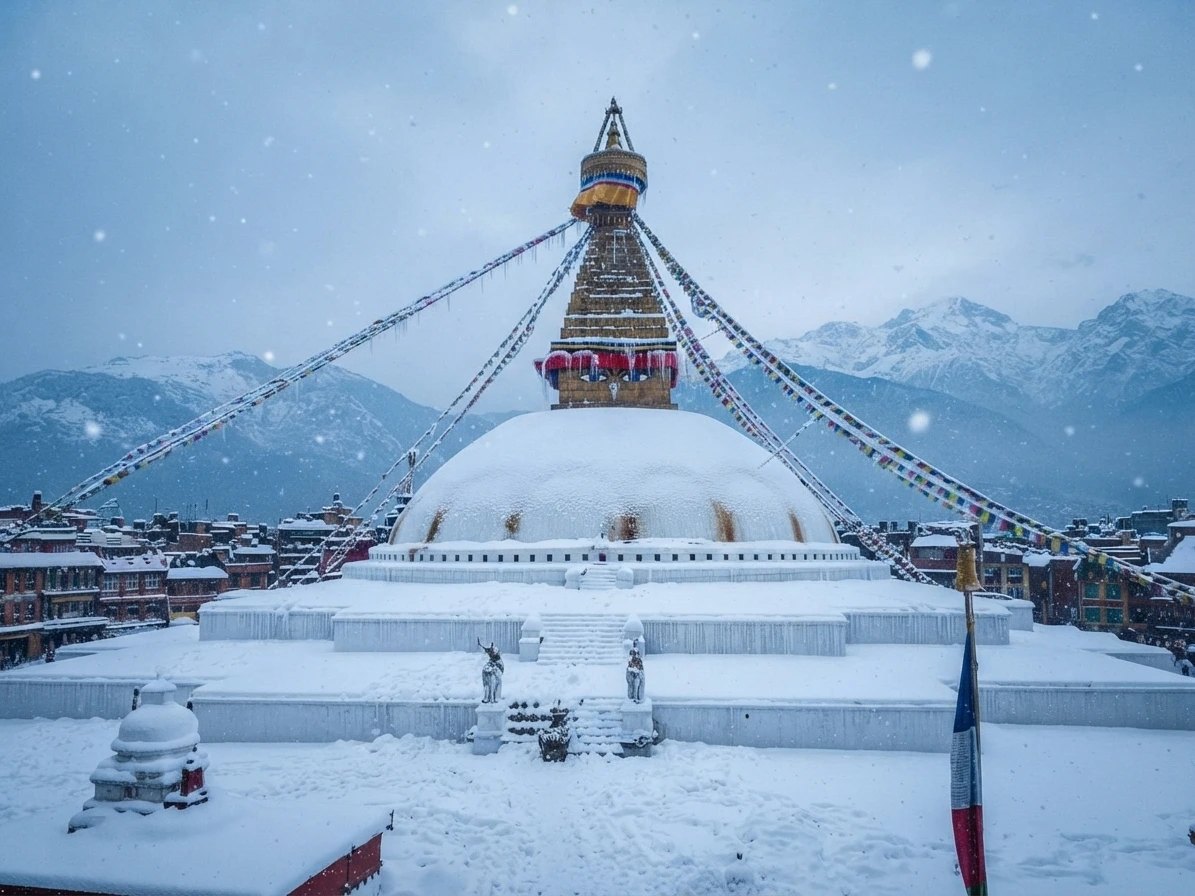
Boudhanath Stupa: Prayer Flags Against a White Sky
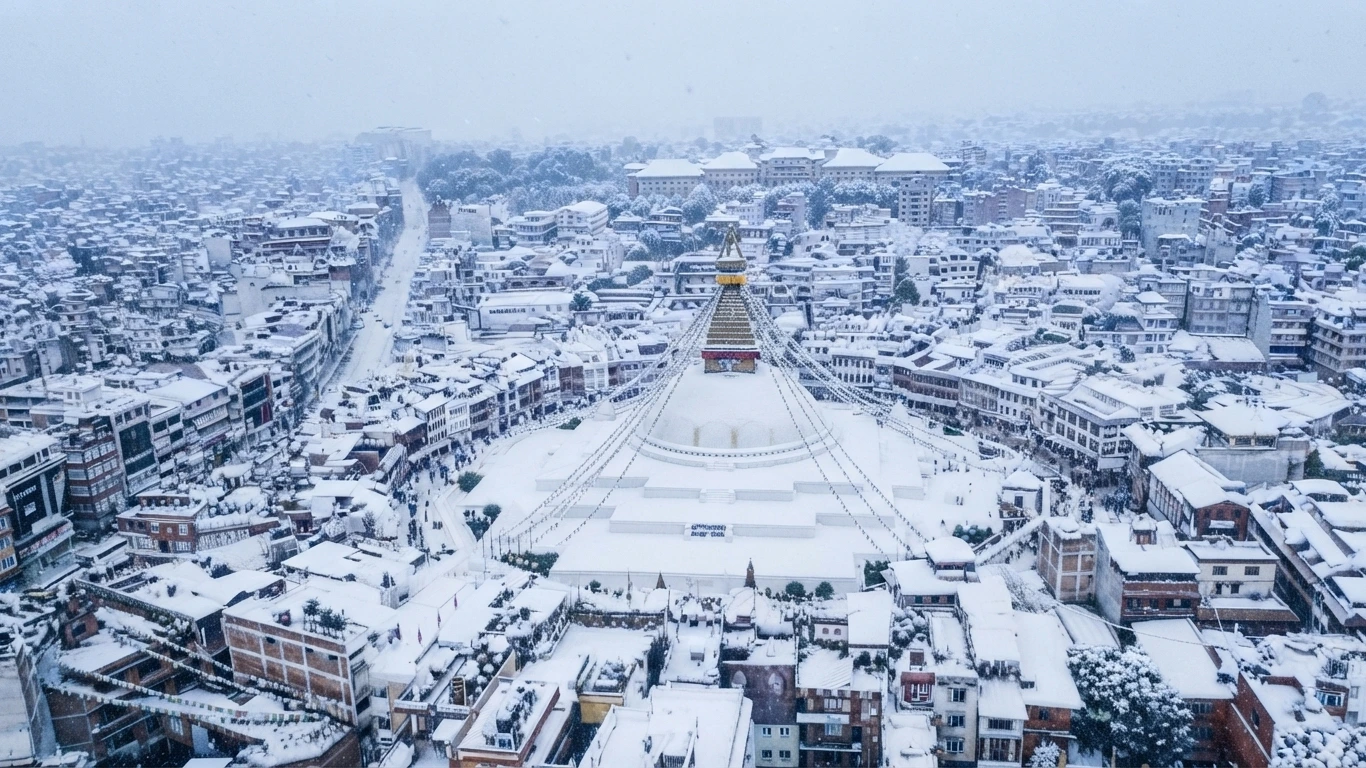
Now imagine travelling to Boudhanath, where the enormous white dome rises above the surrounding neighbourhood. On an ordinary day, the golden spire, colourful prayer flags and steady movement of pilgrims create a scene that is instantly recognisable. In our imagined winter, the dome carries a dusting of snow, and the surrounding rooftops appear pale beneath the cloudy sky.
The prayer flags stretch above the stupa, their colours becoming even more noticeable against the muted landscape. Visitors move around the circular pathway, passing prayer wheels and monasteries as they continue their familiar routines.
The snowfall would create an unusual visual contrast, but the significance of Boudhanath would remain unchanged. It is an important centre of Tibetan Buddhist culture and religious practice, visited by pilgrims and travellers from many parts of the world.
Imagine standing at the edge of the courtyard, watching snowflakes drift past the golden details of the stupa. The city beyond might appear quieter for a moment, while the familiar rhythm of the place continues around you.
For photographers, this would be one of the most striking scenes in our imaginary Kathmandu. The white dome, golden spire, colourful flags and surrounding buildings would create a composition unlike the views most visitors expect to see.
And perhaps that is the most interesting part of this fantasy: a place already known for its beauty would reveal an entirely different side of itself.
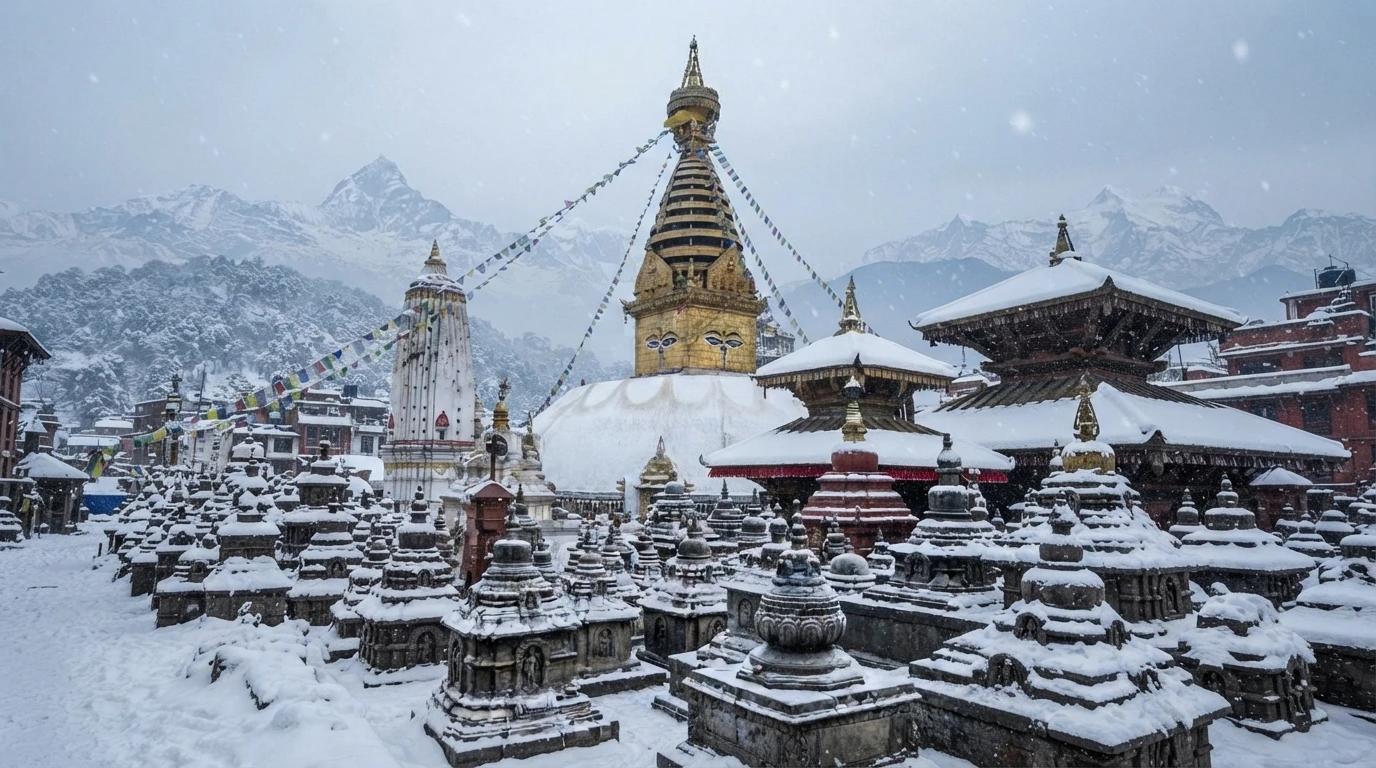
Swayambhunath: Looking Out Over a Snowy Kathmandu Valley
From Boudhanath, our imaginary journey continues to Swayambhunath, the hilltop religious complex commonly known as the Monkey Temple.
The climb to the top is part of the experience. In our fictional winter scene, the stone steps are lightly covered with snow, the surrounding trees have turned pale, and prayer flags flutter in the cold air. As you reach the top, the view opens towards Kathmandu Valley.
Below you, the city looks unfamiliar. Traditional rooftops, modern buildings and distant neighbourhoods stretch across the landscape, while a light mist settles between the hills. The familiar mixture of buildings and busy streets has become a softer pattern of white, grey and red.
The stupa itself stands above the city, its white dome and golden spire contrasting with the winter surroundings. The Buddha’s painted eyes look out over a valley that seems almost unrecognisable.
You might spend several minutes simply looking at the view before remembering to take a photograph.
Swayambhunath is already a rewarding place to visit because it combines religious heritage with a panoramic view of the city. The monkeys, shrines, prayer wheels and surrounding architecture all contribute to the experience. Snow would add another visual layer to a location that is interesting throughout the year.
The view also brings to mind a completely different kind of Himalayan experience. From Kathmandu, the mountains can appear distant and almost unreal, but on a trek, you gradually move closer to the peaks and experience how the landscape changes with elevation. The ridgelines and mountain panoramas that make the Mardi Himal Trek memorable offer a different perspective from looking towards the Himalayas from the valley.
Of course, real snowfall in Kathmandu is uncommon, and this scene is only an imaginative possibility. But it makes you consider how differently the city might appear if its familiar landmarks experienced a genuine winter transformation.
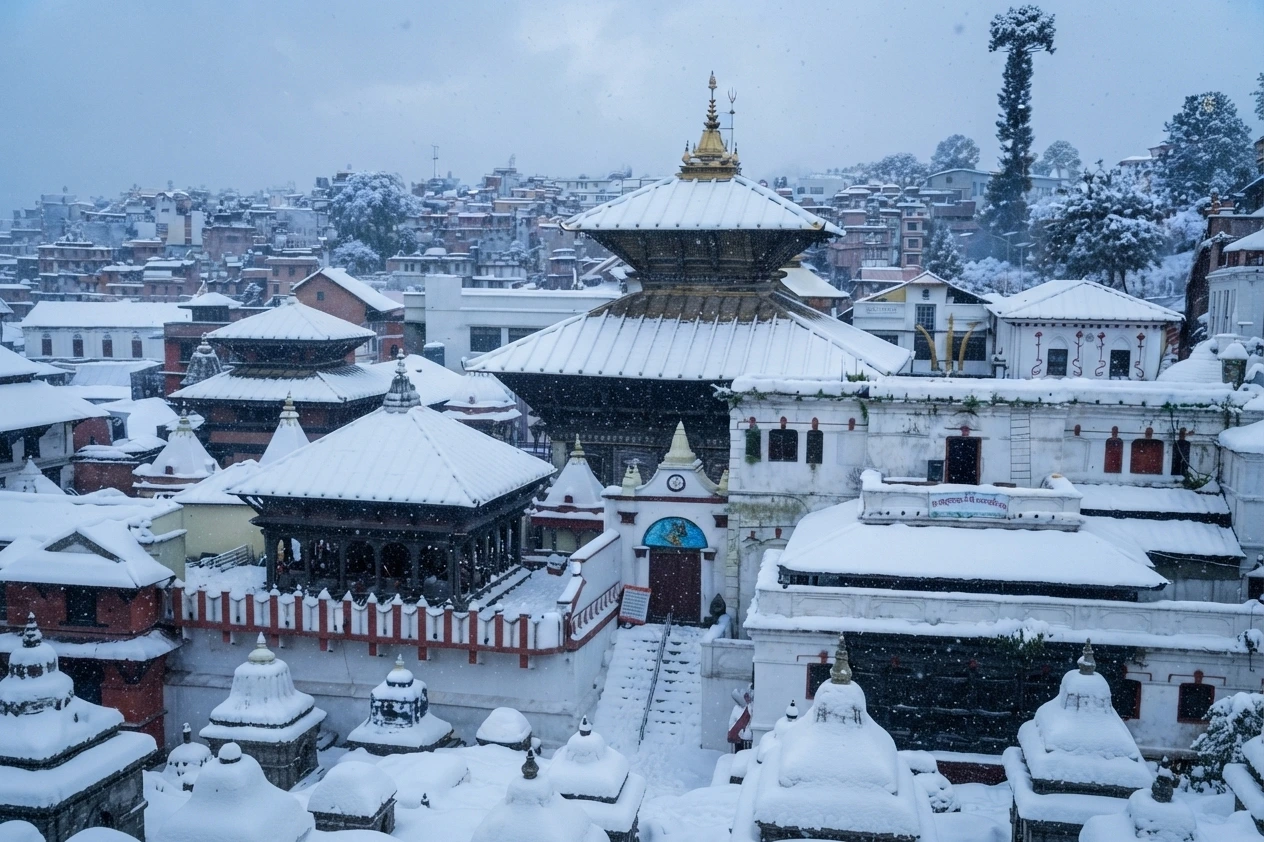
Pashupatinath Temple: A Quiet Scene Beside the Bagmati River
Our next stop is Pashupatinath Temple, one of Nepal’s most important Hindu religious sites. The temple complex stretches along the Bagmati River and contains pagoda-style temples, shrines and sacred spaces connected to centuries of religious tradition.
Imagine the scene beneath a snowy sky. A light covering of snow rests on the rooftops, the surrounding trees look pale, and the river continues flowing through the complex. The familiar architecture takes on a different appearance as the dark wooden details contrast with the white winter landscape.
The atmosphere might feel particularly striking in the early morning, when mist hangs over the river and the surrounding buildings appear through the haze.
Yet Pashupatinath is not simply an architectural attraction. It is an active religious site with deep spiritual significance for Hindu devotees. Any imagined winter scene should respect that reality rather than treating the temple as a decorative backdrop.
In our fictional journey, the snowfall changes the visual setting while the importance of the place remains the same. The river, temples and surrounding religious spaces continue to tell the story of a living tradition.
For visitors exploring Kathmandu Valley, Pashupatinath offers a different experience from the Buddhist heritage of Boudhanath and Swayambhunath. Seeing these locations together helps explain the cultural diversity that makes the valley so distinctive.
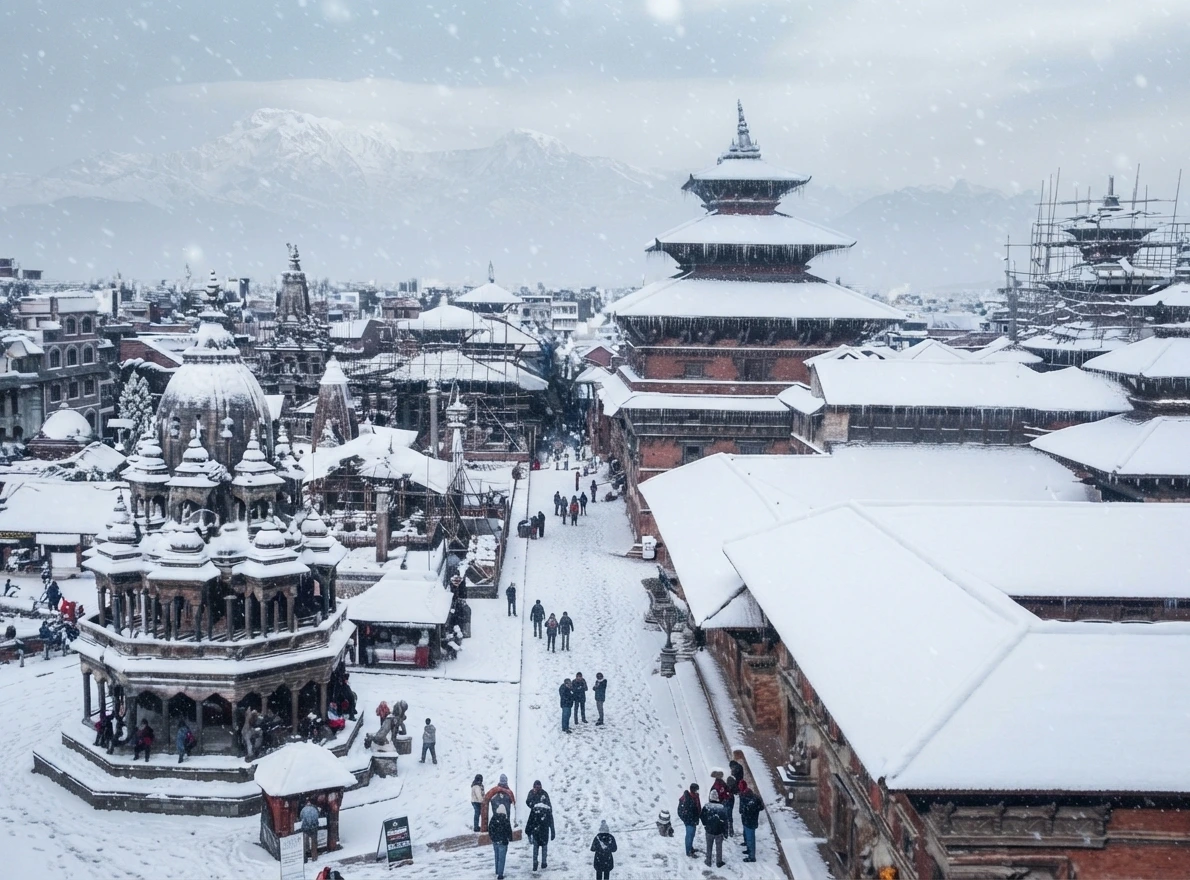
Patan Durbar Square: Red Brick and White Snow
Leaving central Kathmandu, imagine travelling south to Patan Durbar Square in Lalitpur. The historic square is known for its traditional Newari architecture, ornate temples, courtyards and detailed craftsmanship.
Under our imaginary snowfall, the red-brick buildings would stand out against the white rooftops. Snow would collect along the edges of temple roofs, while the stone structures and carved details would appear sharper against the pale surroundings.
Krishna Mandir, with its distinctive stone architecture, would provide a striking contrast to the surrounding pagoda-style buildings. The square’s courtyards would look like scenes from another time, especially if the snow fell quietly during the early morning.
Patan is particularly interesting because its beauty lies in the details. The carved windows, brick façades, temple platforms and traditional streets reward visitors who slow down and look closely.
Imagine walking through the square, stopping to photograph a temple before continuing into the surrounding lanes. You might find another courtyard, a small shrine or a traditional building that looks even more impressive in the winter setting.
The imagined snowfall would give the city a new visual character, but it would not replace the real reasons to visit. Patan’s architecture, craftsmanship and living cultural heritage make it worth exploring in any season.
For anyone planning to explore these historic sites in person, our Kathmandu Valley sightseeing tour provides a practical way to experience the region’s cultural landmarks beyond the images in this article.
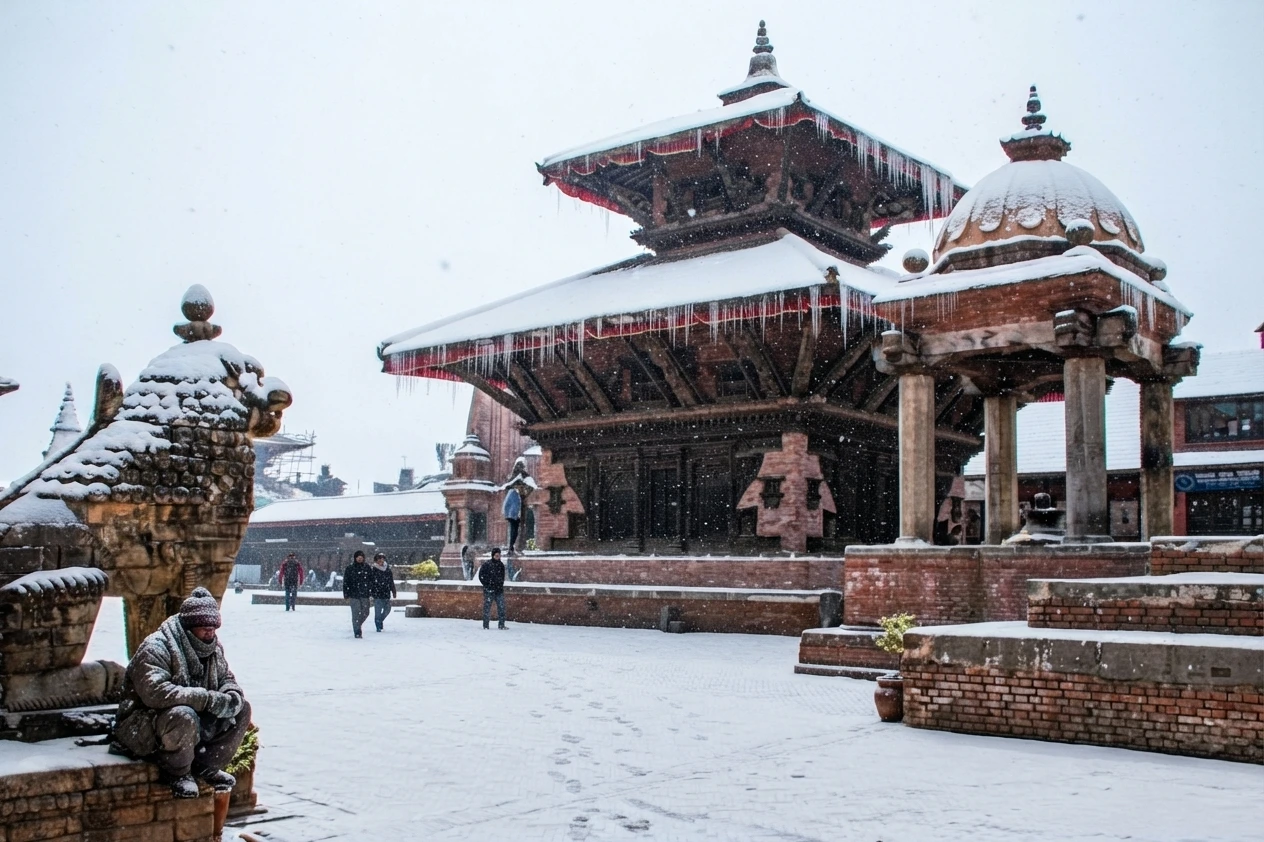
Bhaktapur Durbar Square: A Medieval City in White
Our imaginary journey continues east to Bhaktapur, where traditional brick streets and historic buildings create a different atmosphere from the busy centre of Kathmandu.
Bhaktapur is known for its preserved Newari architecture, traditional courtyards, pottery culture and historic monuments. Its Durbar Square contains important landmarks, including the Golden Gate and the Palace of 55 Windows. Nearby, Nyatapola Temple rises above Taumadhi Square with its distinctive five-tiered structure.
Now imagine the square after a night of snowfall.
A thin layer of white covers the temple steps, the traditional brick buildings look brighter against the winter sky, and the narrow lanes appear almost untouched. The familiar shapes of the city remain visible, but the contrast between snow and brick gives everything a different character.
Nyatapola would be particularly impressive in this imagined scene. Its five levels, stone guardians and tall silhouette would stand above the surrounding buildings, creating a dramatic focal point for photographs.
Beyond the main square, the old streets would offer plenty to explore. Traditional houses, courtyards and pottery areas would reveal different details as you walked through the city.
Bhaktapur deserves more than a quick stop for photographs. Its streets and architecture are part of the experience, and spending time exploring them gives visitors a better understanding of the valley’s cultural heritage.
If snow ever transformed the city in the way we imagine here, it would provide another reason to pause and appreciate the details that are easy to overlook on a busy sightseeing day.
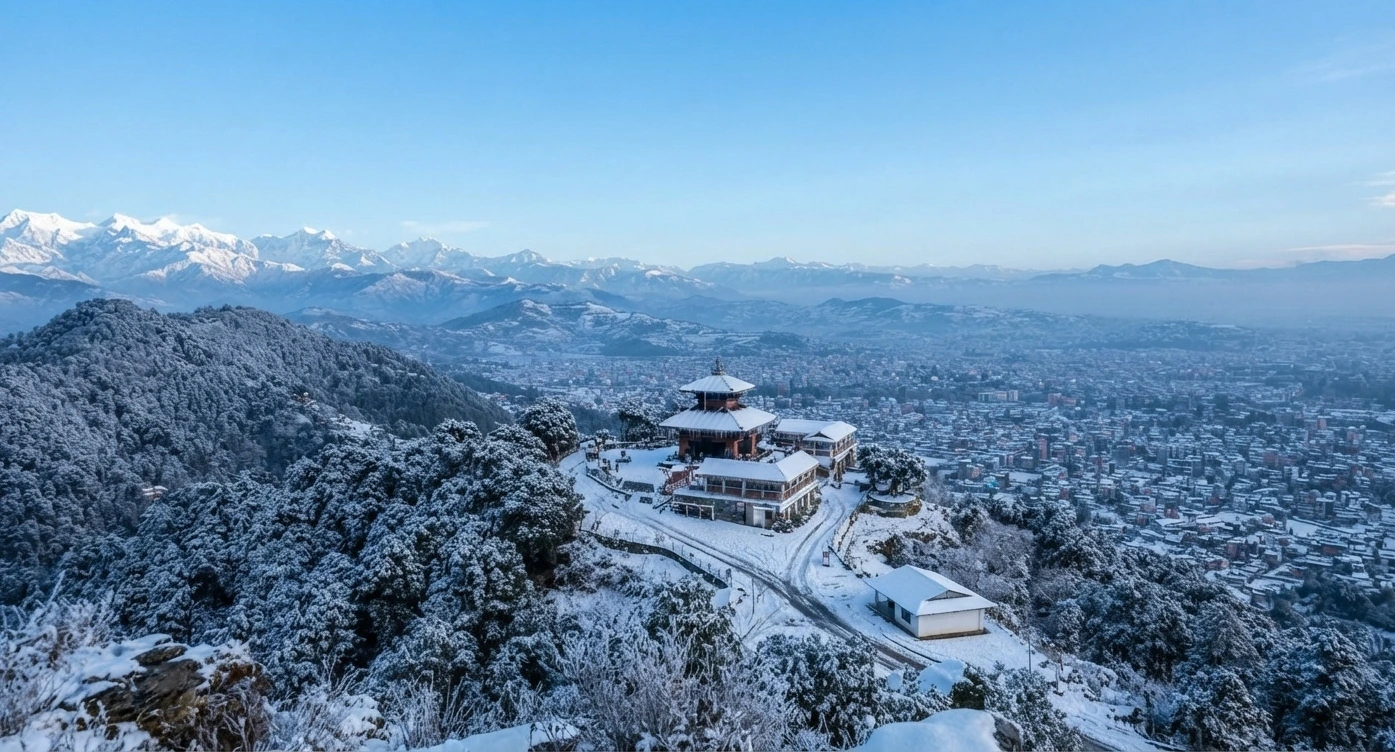
Chandragiri Hills: A Winter View Above the Valley
After exploring the historic squares and sacred sites, our imaginary journey moves above the city to Chandragiri Hills.
The hilltop offers broad views of the surrounding landscape and, on suitable clear days, distant Himalayan peaks. During our fictional winter, the hillsides appear white, the rooftops of the valley are partly hidden by mist, and the mountain skyline emerges behind the clouds.
Imagine standing at a viewpoint and looking towards the city below. Kathmandu’s dense collection of buildings seems smaller from this height, while the surrounding hills create a natural frame around the valley.
This scene would provide a welcome contrast to the architecture of the earlier locations. Instead of concentrating on temples, courtyards and carved windows, the focus shifts towards the landscape surrounding Kathmandu.
The real Chandragiri experience depends on the weather and visibility. Snowfall at the hilltop should not be assumed, and mountain views are never guaranteed. In our article, the snowy landscape is simply an imagined possibility rather than a prediction.
Still, the idea helps show that Kathmandu Valley is more than its historic city centres. The surrounding hills are also part of what makes the region interesting for visitors.
For some travellers, this first glimpse of the Himalayan skyline is only the beginning. Others want to move beyond viewpoints and experience the mountains on foot. The Everest Base Camp Trek takes trekkers deep into the Khumbu, where snow-covered peaks, glacial landscapes and high-altitude valleys become part of the journey rather than a distant view.
Another option for travellers interested in mountain scenery closer to Kathmandu is the Langtang Valley Trek , which leads into a Himalayan valley known for its forests, traditional villages and views of surrounding peaks.
These are very different experiences from a sightseeing tour, but they show how a visit to Nepal can develop from exploring the cultural heart of the country to discovering its mountain landscapes.
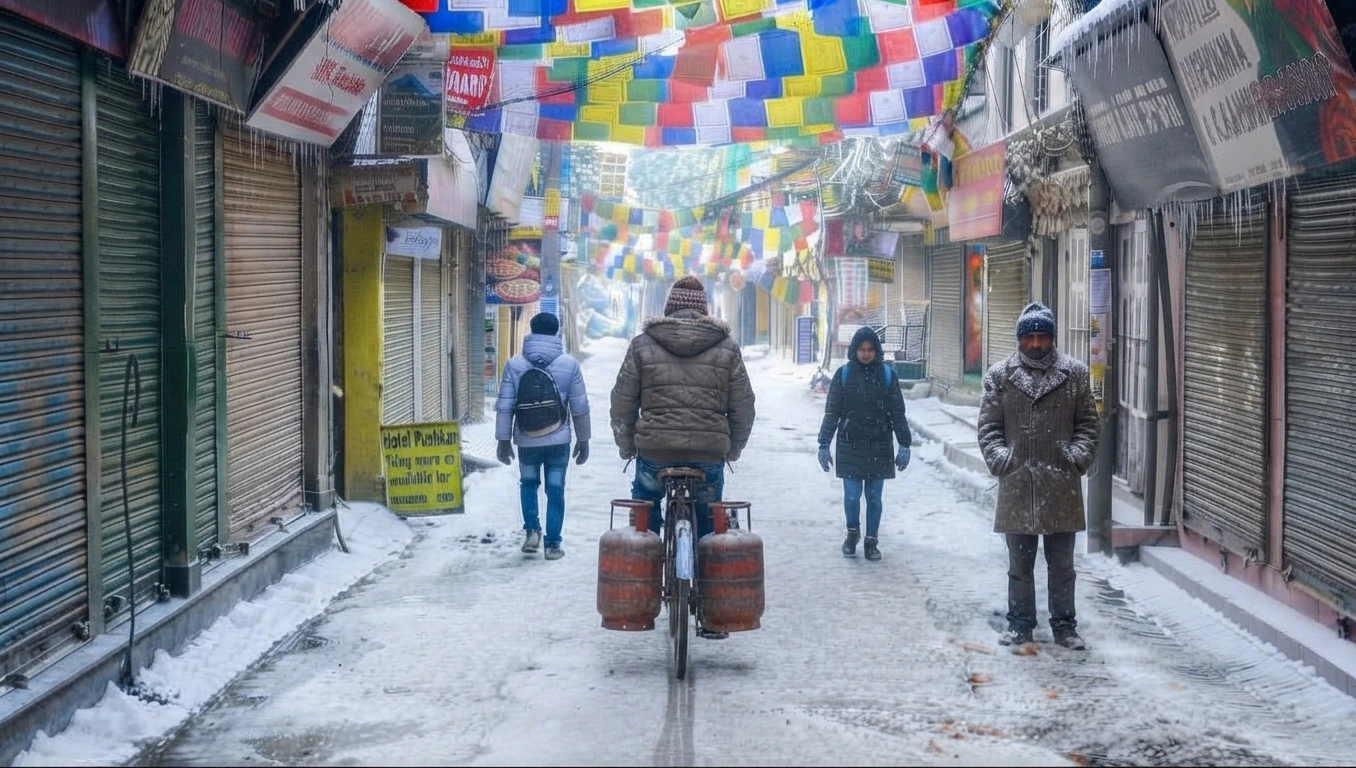
What Would Everyday Life Look Like if Kathmandu Had Snow?
So far, we have imagined the temples, stupas and viewpoints. But what about the people who make Kathmandu feel alive?
Imagine stepping into a narrow street where a shopkeeper is opening the shutters for the morning. A small tea shop is serving hot chiya, and a few visitors stand near the doorway, warming their hands around their cups.
Someone looks at the snow collecting on a rooftop. Another person takes out a phone to photograph a scene they never expected to see. A traveller who planned to spend the morning visiting temples suddenly finds themselves stopping at every street corner.
In our imagined Kathmandu, the snowfall would become more than a change in scenery. It would change the rhythm of the morning.
Of course, real snowfall can also bring difficulties. Roads may become slippery, travel can be disrupted, and daily activities can become more challenging. Historical accounts of Kathmandu’s 1945 snowfall describe both the excitement it created and the problems it caused.
That is an important part of the story. Snow can look beautiful in photographs, but actual winter weather affects the people who live in a place.
The scene we are imagining is not intended to suggest that snowfall would be entirely magical or convenient. Instead, it invites us to think about how a rare weather event might change a familiar city, even if only for a short time.
It also reminds us that travelling is about more than collecting photographs. Sometimes, the most memorable parts of a journey are the ordinary moments: sharing tea with a local, watching a city wake up, or noticing a detail that you would otherwise have walked straight past.
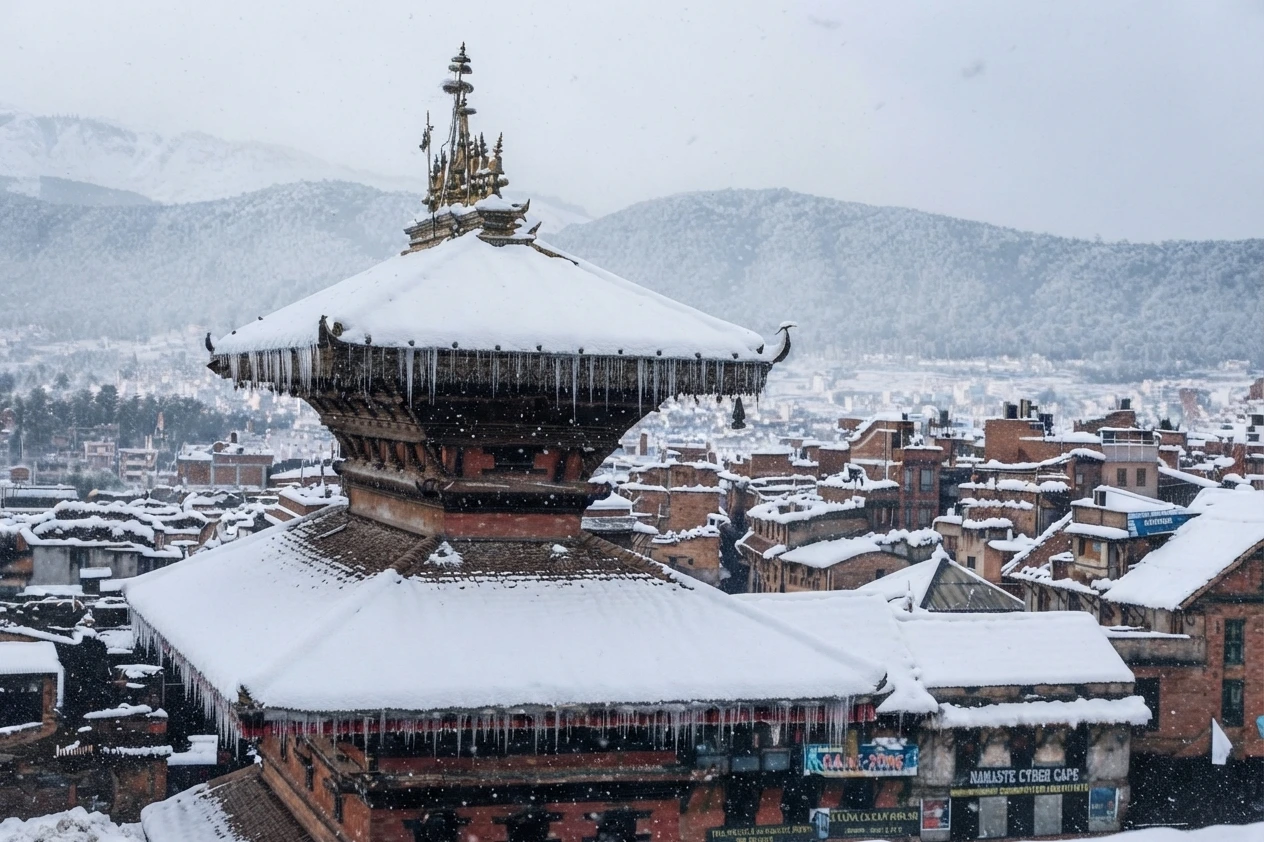
From Kathmandu’s Winter Fantasy to the Snowy Himalayas
There is something interesting about imagining snowfall in Kathmandu. The city sits among hills and mountains, yet its everyday atmosphere is very different from the high Himalayan landscapes that many international visitors associate with Nepal.
In the city, you explore temples, courtyards, markets and neighbourhoods. In the mountains, the experience changes with the terrain. Forest trails gradually give way to open ridgelines, alpine landscapes and views of snow-covered peaks.
On the Annapurna Base Camp Trek, trekkers travel through traditional villages, forested hillsides and the dramatic mountain scenery of the Annapurna Sanctuary. The experience is not about imagining a familiar city beneath snow; it is about travelling into the mountains and seeing how the landscape changes as you walk deeper into the region.
The contrast between Kathmandu and the Himalayas is part of what makes travelling in Nepal so rewarding. You can spend one part of your journey exploring centuries-old heritage sites and another experiencing the scale and quiet of the mountains.
For travellers who have never visited Nepal, Kathmandu can be an introduction to the country’s architecture, traditions and daily life. For those planning a longer adventure, it can also be the starting point for a trek into the Himalayas.
Snowfall in Kathmandu might remain a rare event, but snow-covered mountain scenery is a much more familiar part of Nepal’s high-altitude landscapes. The important thing is to choose the right destination and season rather than expecting the same weather conditions throughout the country.
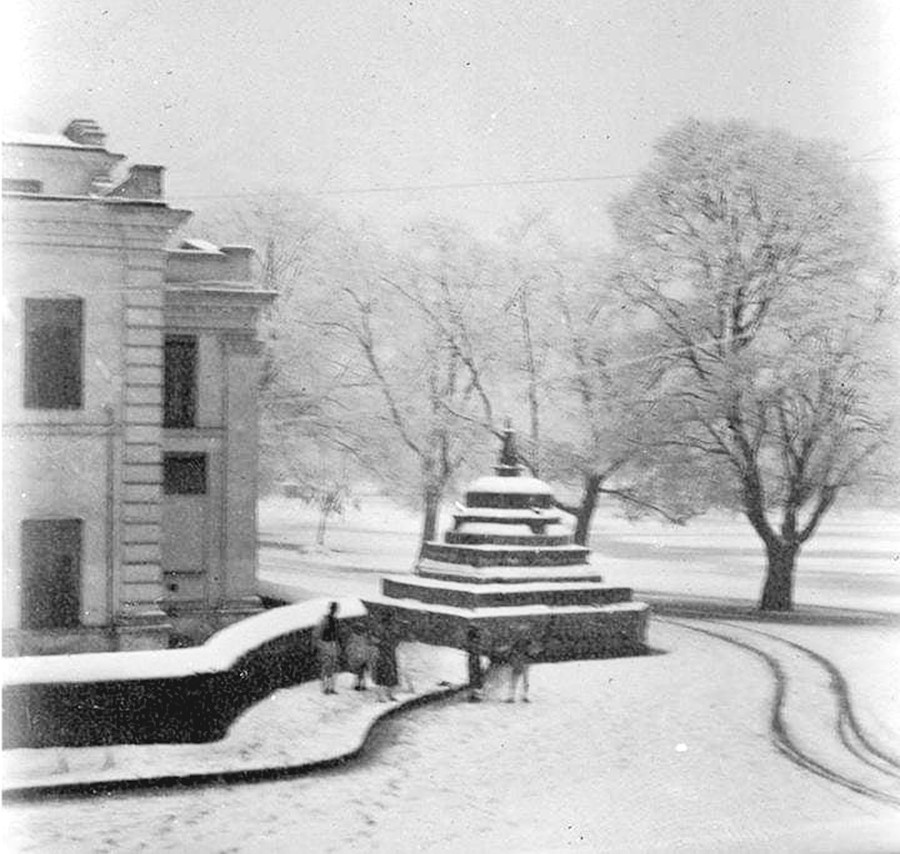
Did Kathmandu Really Experience Snowfall?
Although this article imagines Kathmandu covered in snow, the idea has a real historical connection.
On 6 January 1945, Kathmandu experienced significant snowfall. An account published by The Kathmandu Post describes how snow covered the valley and remained for several days, affecting everyday life as well as creating excitement among residents.
A lighter snowfall was also reported in February 2007. These historical episodes help explain why the possibility of snowfall in Kathmandu continues to capture people’s imagination. It is unusual, but the idea is not entirely fictional.
You can read more in The Kathmandu Post’s historical account, When Snow Came and Stayed in the Valley.
The distinction matters: the historical snowfall is documented, but the snowy scenes of Boudhanath, Pashupatinath, Patan and the other landmarks in this article are creative visualizations, not evidence that those locations experienced the scenes depicted.
This is also why the article uses AI-generated images. They allow us to explore a hypothetical scene without presenting fictional weather as a real event. Each image should be labelled clearly so that readers understand what they are seeing.

Starts from
USD 1,550
Ghorepani Ghandruk Luxury Trek- 09 days
The Ghorepani Ghandruk Luxury Trek is a premium Himalayan adventure that combines the breathtaking beauty of the Annapurna region...
Duration:
09 days
Max altitude:
2,874 meters at Ghorepani
The Real Kathmandu Is Worth Visiting in Every Season
After imagining Kathmandu’s temples, squares and streets covered in snow, it is worth returning to the city we can actually visit.
Kathmandu Valley does not need a winter transformation to be memorable. Its historic architecture, Buddhist stupas, Hindu temples, traditional neighbourhoods, local food and surrounding hills offer plenty of reasons to explore.
A visit to Kathmandu Durbar Square introduces you to the city’s historic heart. Boudhanath and Swayambhunath offer opportunities to experience important Buddhist sites, while Pashupatinath reveals another dimension of Nepal’s religious heritage. Patan and Bhaktapur add their own architecture, craftsmanship and traditional urban character.
For travellers visiting Nepal for the first time, exploring these places can be an excellent introduction before heading towards the Himalayas. Others may prefer to spend more time exploring the valley’s cultural sites, enjoying local food and discovering the neighbourhoods beyond the main tourist attractions.
Silver Moon Adventure & Tours can help visitors plan a real journey through these destinations. Explore our Kathmandu Valley Tour to experience the valley’s cultural landmarks, or browse our trekking adventures in Nepal if you want to continue from the historic city into the mountains.
And perhaps that is the best conclusion to our imaginary trip. Snowfall in Kathmandu would certainly create extraordinary photographs, but the real valley already has something that no artificial winter scene can replace: its living culture, remarkable heritage and the everyday stories unfolding among its historic streets.
You do not need to wait for snow to experience it.
Frequently Asked Questions
1. Does it snow in Kathmandu?
Snowfall in Kathmandu is very rare. Significant snowfall occurred in January 1945, and a much lighter event was reported in February 2007. Snow is not a normal feature of the city’s winter weather.
2. When did Kathmandu last experience snowfall?
Historical reporting documents significant snowfall in 1945 and a lighter event in 2007. These are notable historical examples, not confirmation that no snowfall has occurred since. More recent claims should be checked against reliable weather reports.
3. Could Kathmandu Valley be covered in snow again?
It is possible under unusual weather conditions, but widespread snowfall in the valley is uncommon and cannot be predicted from this hypothetical scenario.
4. Which Kathmandu landmarks would look most striking in the snow?
Kathmandu Durbar Square, Boudhanath Stupa, Swayambhunath, Pashupatinath, Patan Durbar Square and Bhaktapur Durbar Square would all offer distinctive architectural contrasts in an imagined snowy landscape.
5. Are the snowy images in this article real photographs?
No. The images created for this concept are AI-generated visualizations. They illustrate a fictional scenario and should not be presented as documentary photographs of actual snowfall at the landmarks.
6. Is Kathmandu worth visiting during winter?
Yes. Winter can be a good time to explore Kathmandu’s cultural attractions, although mornings and evenings can be cold. Actual conditions vary, so travellers should check the forecast and dress accordingly.
7. Can visitors explore Kathmandu, Patan and Bhaktapur on one trip?
Yes. These destinations can be combined in a Kathmandu Valley sightseeing itinerary, although travel time and the number of sites you want to explore will determine how much can comfortably fit into a day.
8. What are the best places to visit in Kathmandu Valley?
Popular choices include Kathmandu Durbar Square, Swayambhunath, Boudhanath, Pashupatinath, Patan Durbar Square, Bhaktapur Durbar Square and Changu Narayan. Each offers a different perspective on the valley’s cultural heritage.
9. Does Chandragiri Hills always have snow in winter?
No. Snowfall is not guaranteed. Weather conditions vary, and visitors should check local updates before planning a trip specifically to see snow.
10. If Kathmandu really snowed, would I cancel my sightseeing tour and build a snowman on a temple roof?
Probably not. Please leave the historic roofs where they are, respect the religious sites, and enjoy the imaginary snow through our AI-generated pictures instead.

Similar Blogs
View all
13/10/2026
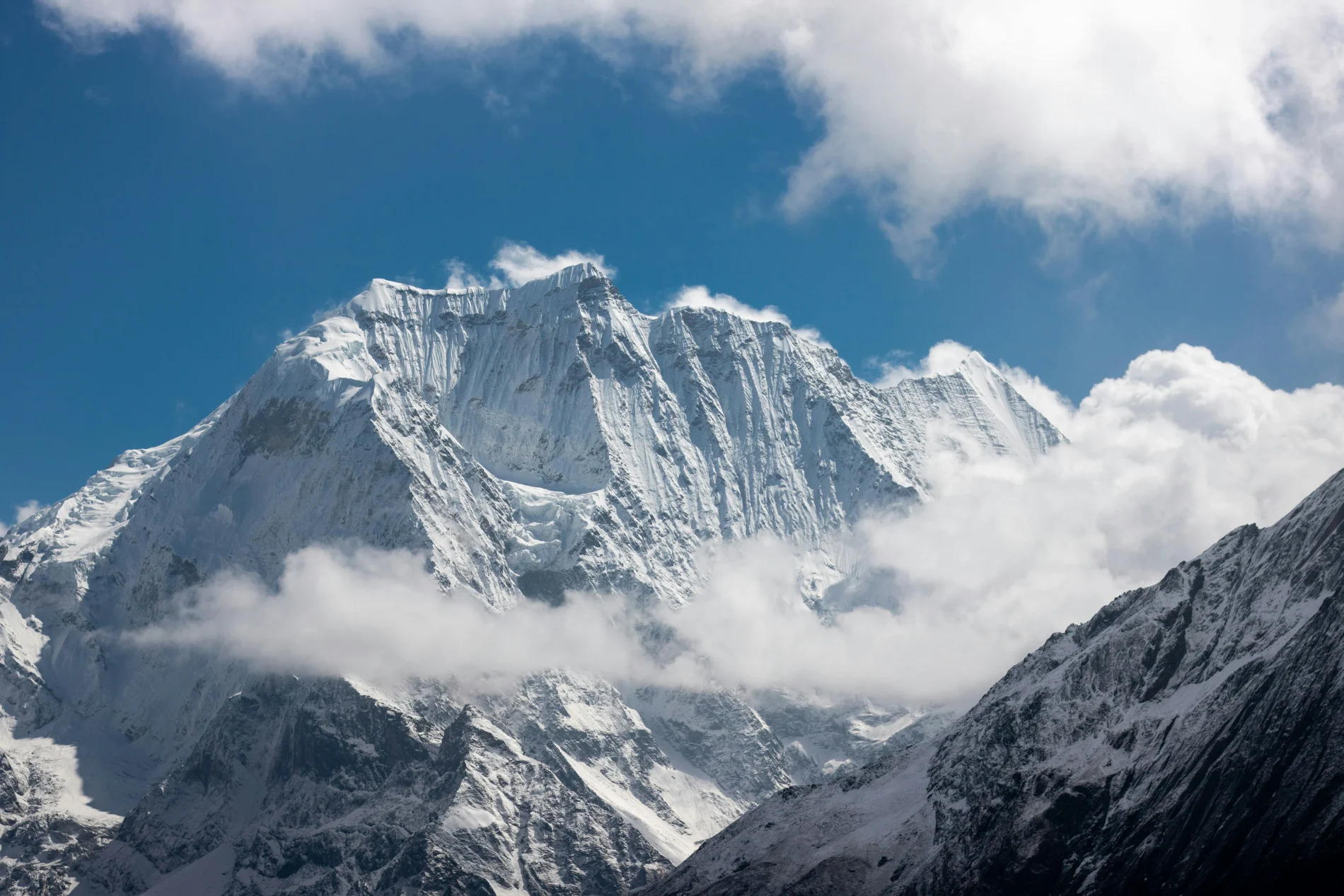
Manaslu Circuit Trek After the October 2026 Floods: Trail Conditions, Safety and Travel Updates
The Manaslu Circuit Trek is one of Nepal’s most rewarding Himalayan journeys, taking trekkers through traditional...
Read more
13/10/2026
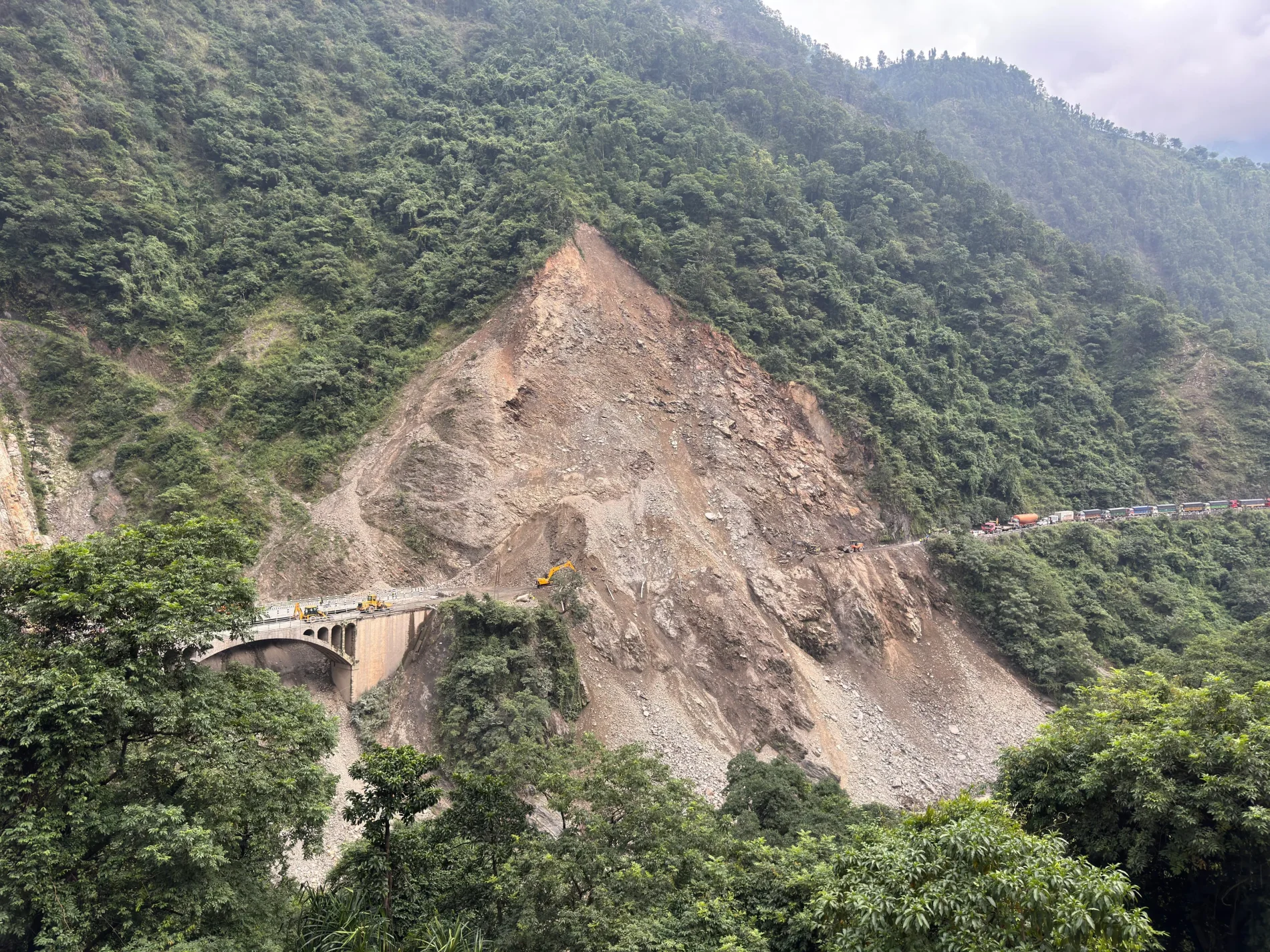
Your Nepal Trek Is Booked, but the Trail Is Closed: What Now?
Imagine arriving in Nepal with your trekking boots ready, your flights booked, your bags packed, and...
Read more